Crypto QR code generator
Generate easy & customizable Crypto QR codes in seconds.
.jpg, .jpeg, .png, .gif allowed. 1 MB maximum.
.jpg, .jpeg, .png, .gif allowed. 1 MB maximum.
.jpg, .jpeg, .png, .gif allowed. 1 MB maximum.

Download
Make sure to test out your configured QR code before using it in production.
Crypto QR Code Generator: Bitcoin, Ethereum & More in Seconds
Whether you're a business accepting crypto, a freelancer getting paid in ETH, or just want to streamline donations, Crypto QR codes make sending crypto as easy as scan, send, done.
In this guide, I'll show you how crypto QR codes work, how to generate one instantly, and how to use them across invoices, websites, merch, and wallet address sharing.
What Is a Crypto QR Code?
A Crypto QR code is a scannable code that contains your crypto wallet address — and optionally, a preset payment amount. When scanned, it launches the sender's crypto wallet app (mobile or web-based) and pre-fills your public address and the requested amount. The sender confirms and sends.
It's the crypto equivalent of a payment QR code in traditional banking. Instead of copying a 42-character Ethereum address or a 34-character Bitcoin address and hoping you didn't miss a character, the QR code handles it perfectly every time.
How a Crypto QR Code Works
Crypto QR codes follow URI schemes (like bitcoin: or ethereum:) that are recognized by most wallet apps. Here's what happens when someone scans your code:
- Their crypto wallet app opens automatically.
- Your wallet address is prefilled in the recipient field.
- If you've specified an amount, that's pre-filled too.
- They confirm the transaction and send.
Example URI:
bitcoin:1BoatSLRHtKNngkdXEeobR76b53LETtpyT?amount=0.01
This tells the wallet: "Send 0.01 BTC to this address." The sender just reviews and taps confirm.
Supported Cryptocurrencies
QRCodeDynamic supports generating QR codes for:
| Cryptocurrency | URI Scheme | Example Address Format |
| Bitcoin (BTC) | bitcoin: | bc1qar0srrr7xfkvy5l643lydnw9re59gtzzwf5mdq |
| Ethereum (ETH) | ethereum: | 0x32Be343B94f860124dC4fEe278FDCBD38C102D88 |
| Elrond (EGLD) | elrond: | erd1... |
Each cryptocurrency has its own address format and URI scheme. You can't mix them — a Bitcoin address in an Ethereum QR code will fail or send funds into the void. Always match the coin to the correct address.
How to Create a Crypto QR Code (Step-by-Step)
Here's the process using QRCodeDynamic. It takes less than 30 seconds.
Step 1: Choose Your Coin
Select one of the supported cryptocurrencies: Bitcoin (BTC), Ethereum (ETH), or Elrond (EGLD).
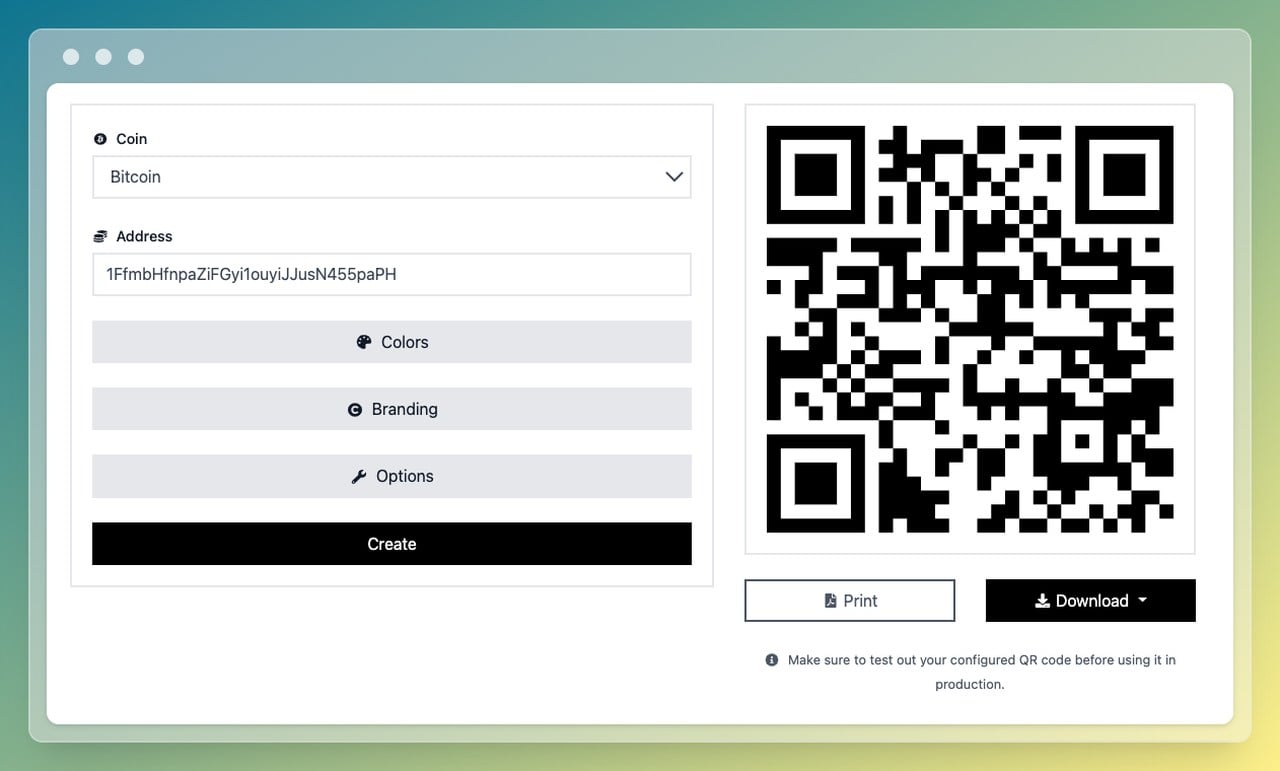
Step 2: Enter Your Wallet Address
Paste your public wallet address. Never your private key or recovery phrase.
Example addresses:
- BTC:
bc1qar0srrr7xfkvy5l643lydnw9re59gtzzwf5mdq - ETH:
0x32Be343B94f860124dC4fEe278FDCBD38C102D88
Double-check your address character by character. Crypto transactions are irreversible — a wrong address means lost funds with no way to recover them.
Step 3: Set an Amount (Optional)
You can specify an exact crypto amount to request — perfect for invoices, donations, or fixed-price items (e.g., 0.01 ETH). Leave blank to let the sender enter the amount manually.
The amount is always in the cryptocurrency's native unit (BTC, ETH, EGLD), not fiat currency. Use a conversion tool to calculate the equivalent amount before generating.
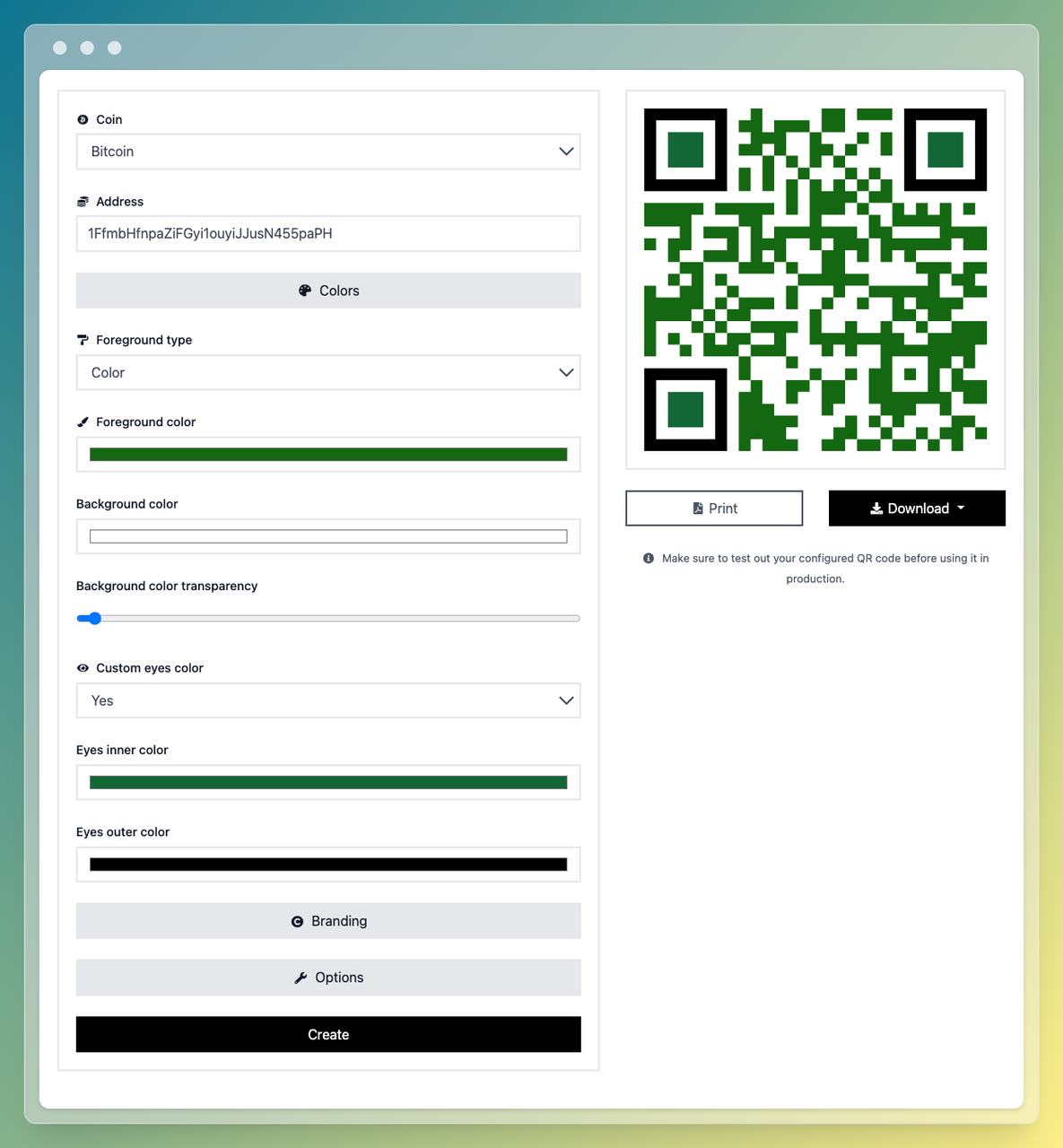
Step 4: Customize the Design
Make your QR code recognizable and trustworthy:
- Choose a QR code CTA like "Send BTC" or "Crypto Accepted"
- Customize colors, logo, corner shapes, and QR eyes
- Add your business logo, donation cause label, or payment tag
Stick with high contrast (dark foreground on light background) for best scan success, especially on paper, packaging, or screens with varying brightness.
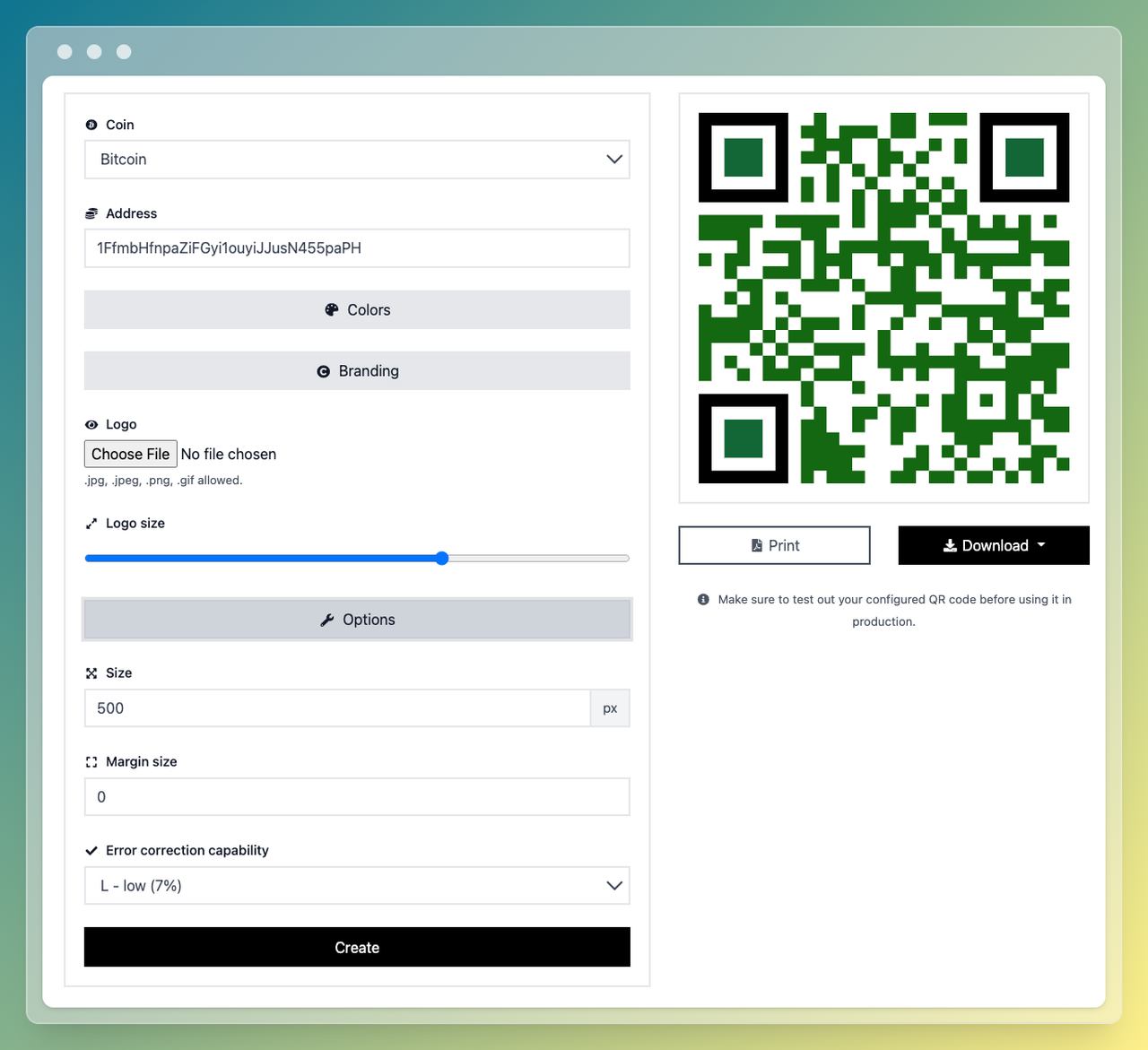
Step 5: Download & Test
- Download as PNG for websites, wallets, emails, and receipts
- Use SVG or PDF for print — stickers, merch, POS terminals
- Test with an actual crypto wallet app to confirm the address and amount are correct before sharing publicly
Send a small test transaction to yourself before launching a public campaign. This confirms the full flow — scan, address prefill, amount, and successful receipt — works end to end.
Security Best Practices for Crypto QR Codes
Crypto transactions are irreversible. A wrong address, a tampered QR code, or an exposed private key means permanent loss. Security isn't optional here.
Never Embed Private Keys
This should go without saying, but it happens: never put private keys, seed phrases, or recovery words in any QR code. Only public wallet addresses belong in a crypto QR code. The public address lets people send to you — it doesn't give them access to your funds.
Verify the Address After Generation
After creating your QR code, scan it yourself with a wallet app and compare the address that appears against your original. Character by character. A single wrong character routes funds to a different wallet with no recovery option.
Watch for QR Code Tampering
If you're printing crypto QR codes on public-facing materials (posters, stickers, booth signage), be aware that someone could physically replace your code with their own. Printed stickers placed over your original QR code would redirect payments to an attacker's wallet. For high-value placements:
- Print directly on the material rather than using peel-and-stick labels
- Use tamper-evident surfaces or sealed enclosures
- Periodically scan your own codes to verify they still resolve to your address
Label Each Coin Separately
If you accept multiple cryptocurrencies, create a separate QR code for each one. Label them clearly: "Send BTC Here" and "Send ETH Here." Sending BTC to an ETH address (or vice versa) results in lost funds. Never combine addresses on a single code or rely on users to figure out which coin goes where.
Use a Dedicated Receiving Address
For privacy and accounting, use a dedicated wallet address for each QR code placement or campaign rather than your primary wallet. This makes it easier to track which campaign generated which payments and limits exposure if any single address is compromised.
Best Practices for Design & Placement
Sizing
| Scanning Distance | Minimum QR Size | Typical Placement |
| 15 cm (6 in) | 1.5 cm | Invoice inserts, receipts |
| 30 cm (12 in) | 3 cm | Business cards, packaging inserts |
| 1 m (3.3 ft) | 10 cm | Posters, booth signage, POS displays |
| 3 m (10 ft) | 30 cm | Storefront windows, banners |
Rule: minimum QR size = scanning distance / 10. For digital use, 180 x 180 px minimum.
Design Rules
- Contrast: Dark foreground on light background for reliable scanning
- Quiet zone: Clear margin of at least 4 modules around the code
- Logo: Small, centered, under 30% of code area — don't obscure finder patterns
- CTA label: "Pay with BTC," "Send ETH," or "Crypto Accepted" — tell people what the code is for and which coin it accepts
Combine QR with a Copy Button
If you're displaying the code on a website, pair it with a "Copy Wallet Address" button. Some users prefer to paste the address manually into their wallet. Others scan. Offering both paths maximizes conversion.
Use Cases for Crypto QR Codes
Small Businesses & Retail
Display crypto QR codes at checkout screens, POS terminals, or register counters. Customers who pay in crypto scan the code, confirm the amount in their wallet, and the transaction processes in seconds. For brick-and-mortar stores, print the code on a small acrylic stand next to the card reader with a clear "We Accept Bitcoin" label.
Freelancers & Consultants
Add your crypto QR code to invoices, proposals, and email footers. Crypto-friendly clients can pay directly without you having to send wallet addresses in plain text over email (which is both error-prone and less professional). Include the specific amount due in the QR code so the client just confirms and sends.
Creators & Artists
Embed crypto QR codes on donation pages, Twitch stream overlays, YouTube video descriptions, and content tip jars. A "Support me with BTC" code on a creator's profile or livestream lets fans tip without navigating a payment platform. NFT artists can include payment QR codes on physical prints or gallery cards.
E-commerce & Product Packaging
Include crypto payment QR codes as stickers or inserts in packaging: "Love the product? Send crypto to support us." For e-commerce checkout pages, display the QR alongside traditional payment options. Some customers actively prefer crypto for privacy or because they hold assets they'd rather spend than convert to fiat.
Nonprofits & Fundraising
Share donation QR codes on social media, printed flyers, event signage, and fundraising emails. Crypto donations are often tax-advantageous for donors (no capital gains tax on donated appreciated assets in many jurisdictions), so offering a crypto option can attract larger donations from holders who wouldn't donate fiat.
Events & Conferences
Print crypto QR codes on booth signage for accepting payment for products or services sold at the event. Crypto-focused conferences and meetups can use them for ticket sales, merchandise, and sponsor donations — audiences at these events are already wallet-ready.
Static vs. Dynamic Crypto QR Codes
Crypto QR codes are typically static — the wallet address and amount are encoded directly into the pattern. This is the safest approach because there's no redirect that could be intercepted or modified.
| Feature | Static Crypto QR | Dynamic (URL-based) |
| Edit after printing | No | Yes (via redirect to payment page) |
| Scan analytics | No | Yes |
| Works offline | Yes (wallet still needs internet for transaction) | Needs internet for redirect + transaction |
| Direct wallet integration | Yes (opens wallet app directly) | Extra step (load page, then tap to pay) |
| Security | Higher (no middleman) | Redirect could be compromised |
| Best for | Long-term wallets, print, invoices | Campaigns, rotating wallets, analytics |
For crypto payments, you can use static codes in almost every case. The direct wallet-app handoff is faster, works offline (the wallet needs internet for the transaction itself, but not for reading the QR), and eliminates the security risk of a redirect being hijacked. Use dynamic only if you genuinely need to change the wallet address after printing or require scan-level analytics.
Generate Your Free Crypto QR Code Now
Create your crypto payment QR code in seconds on QRCodeDynamic:
- Choose your coin (BTC, ETH, EGLD)
- Enter your wallet address
- Set an amount (optional)
- Customize the design
- Download and test with a wallet app
- Free, unlimited static crypto QR codes
- Support for Bitcoin, Ethereum, and Elrond
- Fully customizable: colors, logos, CTA frames
- Instant download in PNG, SVG, PDF, or JPG
- No login required for static codes
FAQs About Crypto QR Codes
Are crypto QR codes safe?
Yes, as long as you only include your public wallet address. The public address lets people send funds to you — it doesn't give anyone access to your wallet. Never include private keys, seed phrases, or recovery words in any QR code. Also verify the address after generation by scanning the code yourself before sharing.
Can I include a dollar amount instead of crypto?
No. Crypto QR codes use the cryptocurrency's native amount (e.g., 0.01 BTC, 0.5 ETH). Fiat amounts aren't supported in the URI scheme. Use a conversion tool to calculate the equivalent crypto amount at current rates, and note that the value will fluctuate — a code requesting 0.01 BTC today may represent a different dollar value tomorrow.
Which wallets support QR scanning?
Most major wallets support QR-based sending: Coinbase, MetaMask (mobile), Trust Wallet, Binance, Ledger Live, Exodus, and Phantom (for supported chains). The wallet reads the URI scheme, recognizes the address and optional amount, and pre-fills the send form. Always test with the specific wallet your audience is most likely to use.
Can I accept multiple coins with one QR code?
No. Each cryptocurrency requires its own wallet address and its own QR code. A Bitcoin address can't receive Ethereum, and vice versa. If you accept BTC and ETH, create two separate codes and label them clearly. Sending crypto to the wrong chain's address results in permanent loss.
What happens if I enter the wrong wallet address?
Funds sent to a wrong address are gone. Crypto transactions are irreversible — there's no bank to call, no chargeback, no recovery process. This is why double-checking your address and testing with a small transaction before public deployment are non-negotiable steps.
Can I update the wallet address after printing?
Not with a static crypto QR code — the address is permanently encoded. To change it, generate a new code and reprint. If you need post-print flexibility (e.g., rotating wallet addresses for security), use a dynamic URL QR code linking to a payment page where you can update the address. The tradeoff: a dynamic code adds a redirect step and requires internet, which slightly reduces the seamless wallet-app experience.
Do crypto QR codes work offline?
The scan itself works offline — the phone reads the wallet address from the QR pattern. But completing the transaction always requires an internet connection, since crypto transfers are processed on the blockchain network. So the code can be scanned anywhere, but the payment can only be sent where there's connectivity.
Can I use a crypto QR code for recurring payments?
Crypto QR codes handle one-time transactions. Each scan prefills the address (and optional amount) for a single payment. There's no built-in way to set up recurring transfers via a QR code — that requires wallet-level or platform-level automation (e.g., through a payment processor like BitPay or Coinbase Commerce). The QR code is best suited for individual send events.
How volatile is a preset amount in a crypto QR code?
Very. A QR code requesting 0.01 BTC today might be worth $600 or $700 depending on the market. If you set a fixed crypto amount, the fiat equivalent changes constantly. For invoicing, generate the QR code close to the time of payment and note the conversion rate used. For tip jars and donations where the exact amount is flexible, leaving the amount blank and letting the sender choose is usually the better approach.