Event QR code generator
Generate easy & customizable Event QR codes in seconds.
.jpg, .jpeg, .png, .gif allowed. 1 MB maximum.
.jpg, .jpeg, .png, .gif allowed. 1 MB maximum.
.jpg, .jpeg, .png, .gif allowed. 1 MB maximum.
Download
Make sure to test out your configured QR code before using it in production.
Event QR Code Generator: Share Event Details in One Scan
Whether you're organizing a conference, concert, webinar, or pop-up, getting attendees to save the date shouldn't be a hassle.
With an Event QR Code, your guests can add your event to their digital calendars — Google, Apple, Outlook — in one tap. No typos. No missed dates. Just better attendance.
In this guide, I'll show you how event QR codes work, how to make one in seconds using QRCodeDynamic, and where they make the biggest difference for conferences, webinars, product launches, and everyday team meetings.
What Is an Event QR Code?
An event QR code is a scannable code that encodes all the critical details of an event — title, date, time, location, timezone, and optional reminder alerts.
When scanned, it prompts the user to save the event to their calendar app with all the info pre-filled. It's a one-tap calendar add without needing a registration platform or a separate RSVP link.
Most devices (Android and iOS) support .ics calendar files by default, so scanning works natively — ideal for both printed invitations and digital event promotion.
How an Event QR Code Works
When someone scans an event QR code:
- Their device detects the event info embedded in .ics format.
- It opens their default calendar app (Google Calendar, Apple Calendar, Outlook, etc.).
- All fields — event name, date, time, location, alerts — are pre-filled.
- They tap Save, and it's added to their schedule.
The .ics format is a universal calendar standard. It works across every major calendar app without conversion or compatibility issues. The event data is encoded directly into the QR pattern, so the scan works even without an internet connection.
What Gets Encoded in an Event QR Code
Event QR codes use the .ics (iCalendar) format, which is the universal standard for calendar data. Here's what you can include:
| Field | What It Does | Example |
| Event name | Title that appears in the calendar | "Product Launch 2026" |
| Start date & time | When the event begins | March 15, 2026, 2:00 PM |
| End date & time | When the event ends | March 15, 2026, 5:00 PM |
| Location | Physical address or virtual meeting note | "123 Broadway, NYC" or "Zoom — link in inbox" |
| Timezone | Ensures correct time display globally | America/New_York, Europe/London |
All of this is baked into the QR code itself. No server, no landing page, no internet required for the scan. The calendar app reads the .ics data and creates the event locally.
How to Create an Event QR Code (Step-by-Step)
Here's the process using QRCodeDynamic. It takes under a minute.
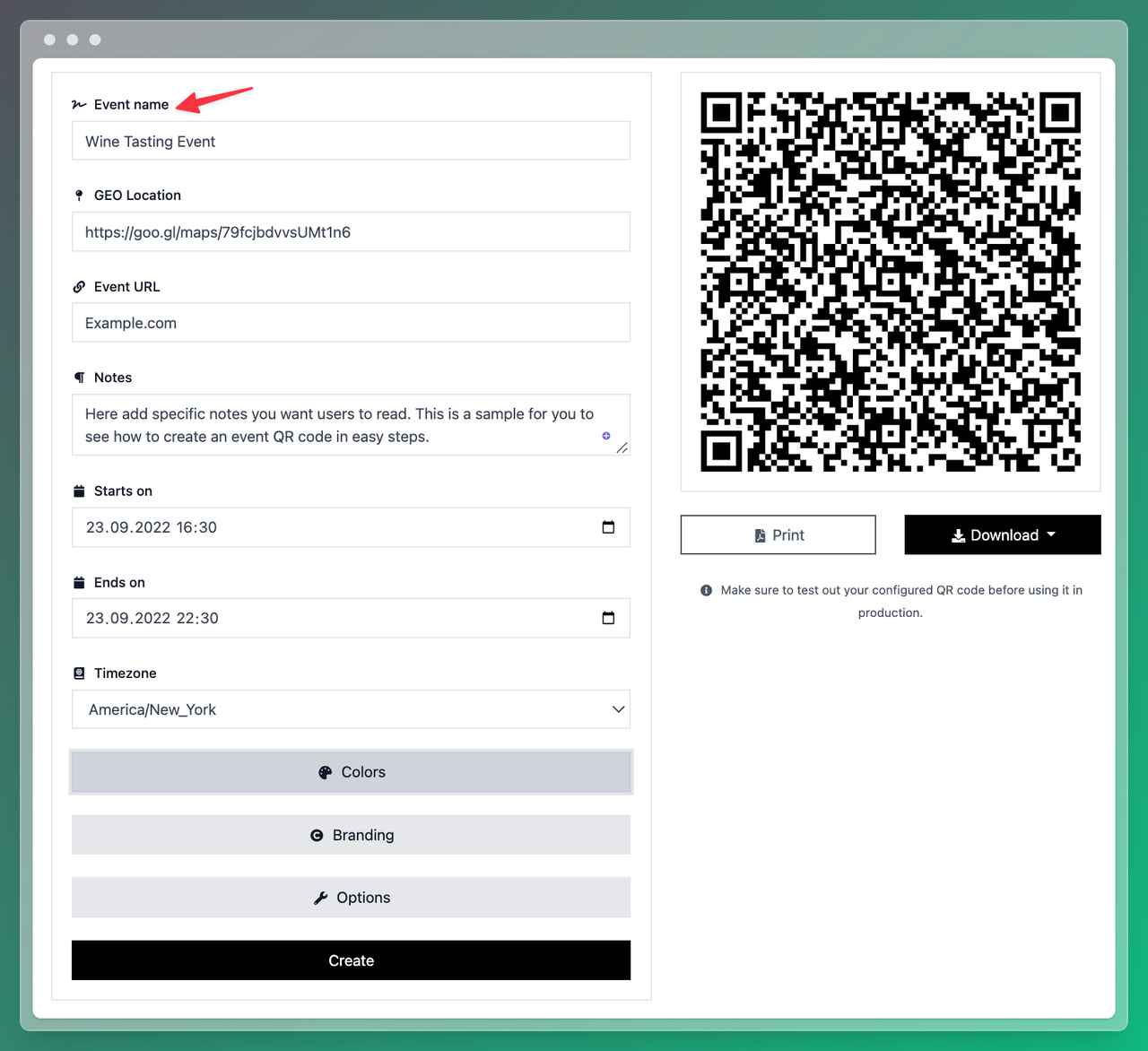
Step 1: Fill in Event Details
- Event name: e.g., "Product Launch 2026" or "Webinar: AI in Customer Support"
- Location: A physical address ("123 Broadway, NYC") or a note for virtual events ("Online — Zoom link in inbox")
- Start & end time: Choose date and time with the calendar picker
- Timezone: Critical for remote or international audiences — the event will display at the correct local time on each attendee's device
- Reminders (optional): Set up to two alerts, like 1 day before and 30 minutes before
Step 2: Customize Design & CTA
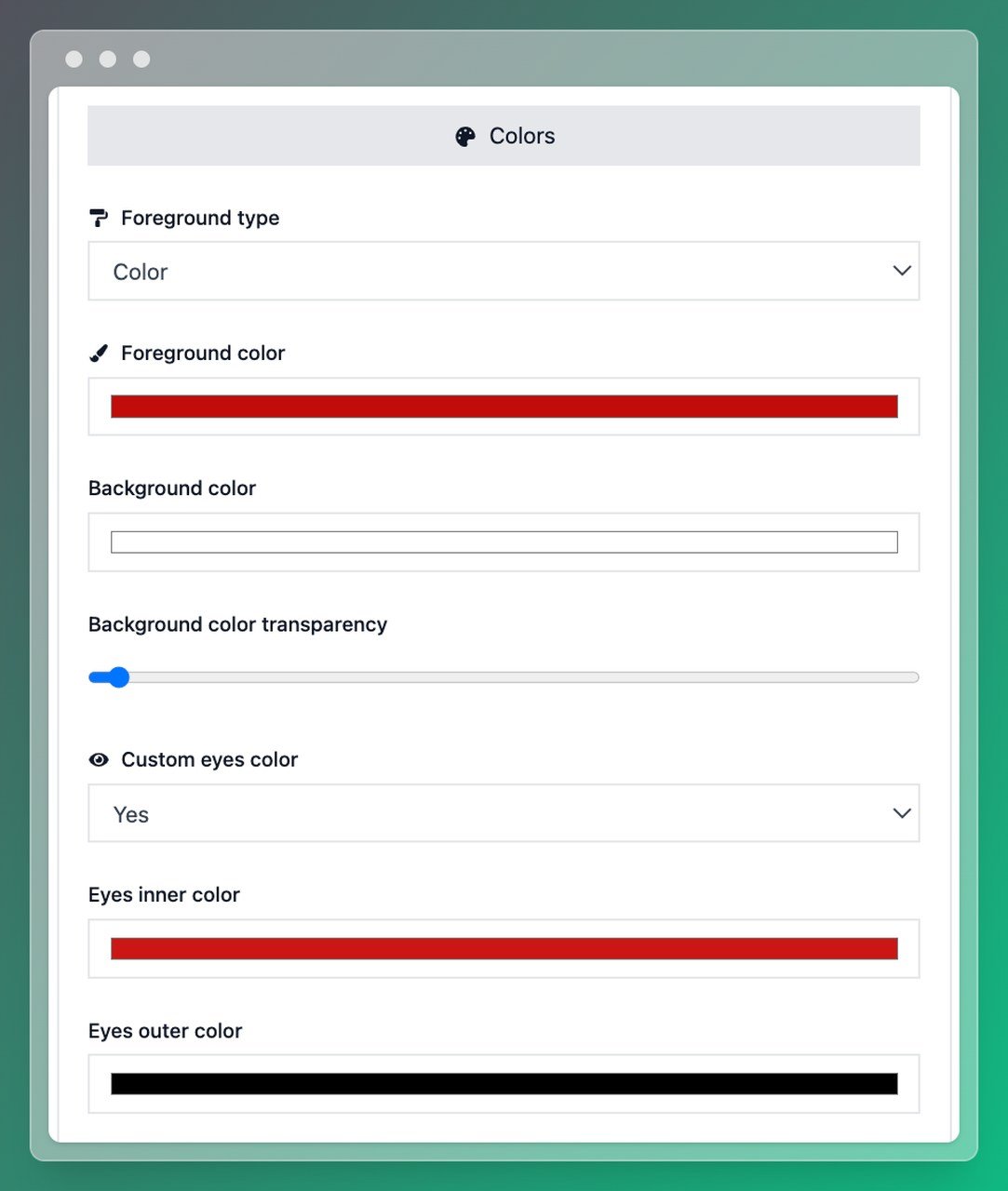
- Choose a color scheme that fits your flyer, invite, or webpage
- Pick a QR code CTA frame like "Scan to Save the Date" or "Add to Calendar"
- Add a logo (your brand, artist, sponsor, etc.)
- Adjust corner shapes and eye patterns for a polished look
High contrast (dark foreground on light background) works best for scan success on printed materials. Don't sacrifice readability for aesthetics.
Step 3: Download & Test
- Download in PNG for screens, SVG or PDF for print
- Embed in email invites, posters, product launch kits, name badges, or digital RSVPs
- Test with a phone before printing — confirm all calendar fields show correctly, especially the timezone
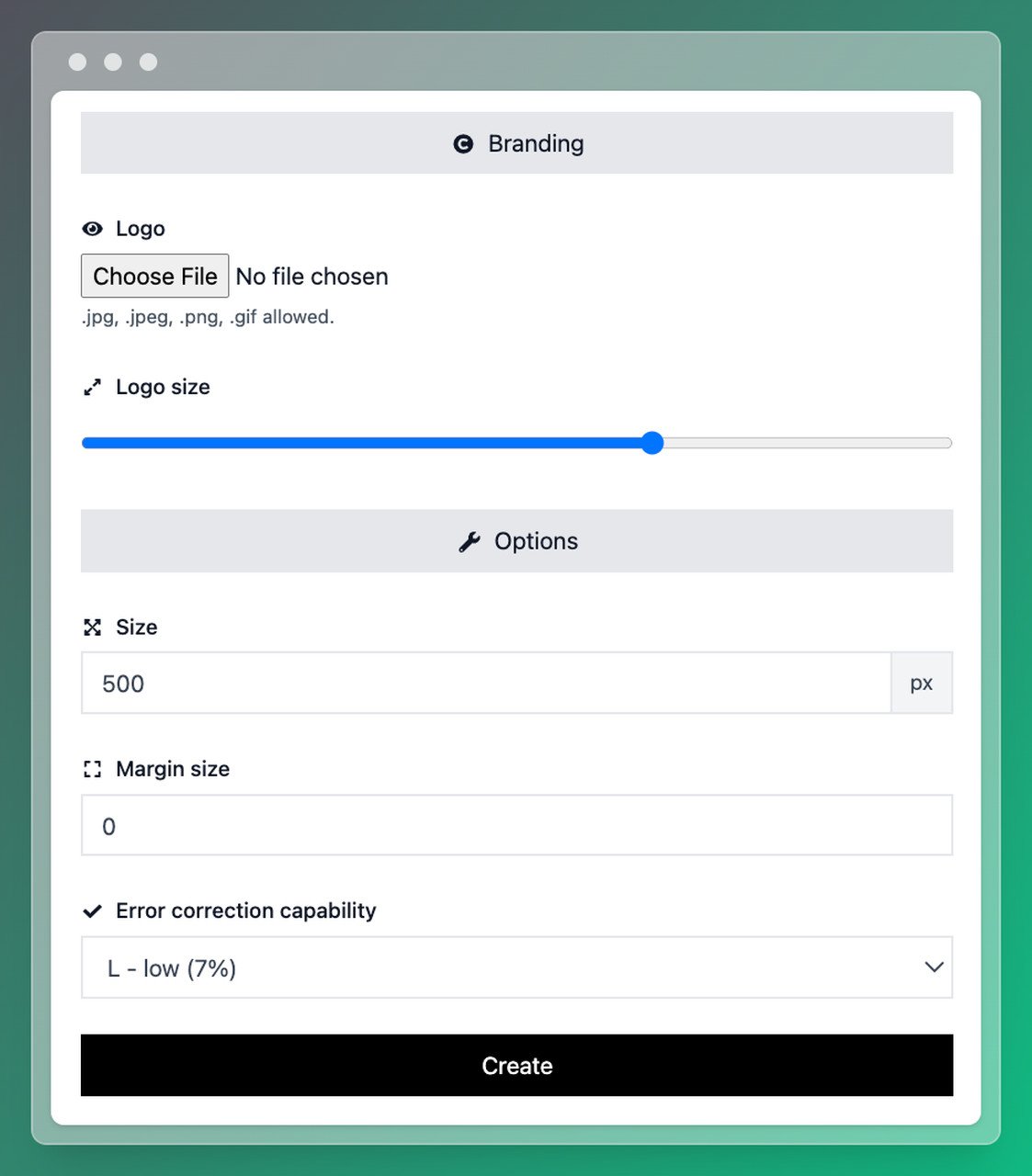
Don't forget to verify the timezone if your audience is remote. A missing or incorrect timezone means the event appears at the wrong time on attendees' calendars — and you won't know until nobody shows up.
Best Practices for Event QR Codes
Always Specify the Timezone
This is the most common mistake with event QR codes. If you skip the timezone or leave it as a default, the .ics file may assume the scanner's local time — which is fine if everyone is in the same city, but disastrous for webinars, virtual events, or multi-country conferences. Always set the timezone explicitly.
Use Dual Reminders
Two alerts work better than one. Set the first reminder for 1 day before (so attendees can plan) and the second for 15–30 minutes before (so they actually show up). Calendar apps support both alerts from the .ics data — no extra setup needed from the attendee.
Write a Clear Event Name
The event name is what people see in their calendar for weeks before the event. "Team Meeting" is useless if someone has three of those. "Q2 Product Roadmap Review — Marketing Team" tells them exactly what it is and whether they need to attend. Be specific in the title because the calendar entry is often the only reminder they'll see.
Sizing
| Scanning Distance | Minimum QR Size | Typical Placement |
| 15 cm (6 in) | 1.5 cm | Business cards, ticket stubs |
| 30 cm (12 in) | 3 cm | Invitations, postcards, email embeds |
| 1 m (3.3 ft) | 10 cm | Posters, booth signage, venue displays |
| 3 m (10 ft) | 30 cm | Banners, storefront windows, stage screens |
Rule: minimum QR size = scanning distance / 10. For digital use, 180 x 180 px minimum.
Use It Digitally Too
Event QR codes aren't just for print. Embed them in confirmation emails, website popups, WhatsApp messages, and social media posts. A QR code in a registration confirmation email lets the attendee add the event to their calendar immediately after signing up — while intent is highest.
Design Rules
- Contrast: Dark foreground on light background for reliable scans
- Quiet zone: Leave a clear margin of at least 4 modules around the code
- Logo: Small, centered, under 30% of code area
- CTA label: "Scan to Add to Calendar" or "Save the Date" — without a label, people assume it's a URL and may not bother scanning
Use Cases for Event QR Codes
Conferences & Summits
Print event QR codes on lanyards, booth signs, and session schedules so attendees can save individual keynotes and breakout sessions to their calendars. Multi-day conferences benefit from separate codes for each session — attendees build their own schedule by scanning the sessions they're interested in.
Webinars & Virtual Events
Include the QR code in registration confirmation emails and on the event landing page. Attendees scan and the webinar appears in their calendar with the correct timezone and a reminder. This reduces no-shows because the event is in their calendar instead of buried in a forgotten email.
Product Launches
Add event QR codes to packaging, teaser flyers, and social media posts for live launch streams. A code on the product box that says "Scan to Save Launch Event" lets customers add the livestream to their calendar while the product is still in their hands — peak interest moment.
University Events
Open days, seminars, lectures, guest talks, and orientation sessions all benefit from event QR codes on campus signage and printed schedules. Students scan the sessions they want to attend, and the events appear in their phone calendars with reminders. No more missed lectures because "I forgot it was today."
Internal Team Meetings
All-hands meetings, lunch-and-learns, training sessions, and team offsites — especially in hybrid workplaces where not everyone checks the same tools. A QR code on a poster in the break room or a Slack message gets the event into everyone's calendar regardless of which app they use.
Weddings & Personal Events
Print event QR codes on save-the-date cards, wedding invitations, and ceremony programs. Guests scan and the event lands in their calendar with the venue address, ceremony time, and a reminder the morning of. For multi-part events (ceremony at one location, reception at another), use separate codes with clear labels.
Recurring Events
Weekly meetups, monthly book clubs, or biweekly team standups can use event QR codes for the next occurrence. Post a fresh code each cycle on a bulletin board, group chat, or recurring newsletter. Since event QR codes are static, you'll generate a new one for each date — but it takes seconds.
Static vs. Dynamic Event QR Codes
Event QR codes are typically static — the .ics data is encoded directly into the QR pattern. This means you can't change the event details after printing.
| Feature | Static Event QR | Dynamic Event QR |
| Edit after printing | No | Yes (via redirect to hosted event page) |
| Calendar integration | Yes (direct .ics) | Yes (user downloads .ics from page) |
| Reminder alerts | Yes (embedded in .ics) | Yes (embedded in .ics on hosted page) |
| Scan analytics | No | Yes (time, device, location) |
| Works offline | Yes | Needs internet for redirect |
| Cost | Free | Paid tiers common |
If your event details are final and you don't need scan tracking, static is the simplest choice. The .ics file opens directly from the scan with no internet required.
If the event date, time, or venue might change after you've printed the codes, use a dynamic URL QR code that links to a hosted event page. You can update the page (and the downloadable .ics file on it) without reprinting. The tradeoff: the user needs internet to load the page, and there's an extra tap to download the calendar file.
Troubleshooting Event QR Codes
- Event appears at wrong time on attendee's calendar: The timezone is missing or incorrect. Always set it explicitly in the generator — don't rely on defaults.
- Calendar app doesn't open after scan: Some older devices or custom Android skins may not handle .ics data natively from a QR scan. The attendee may need to save the .ics file manually and open it. This is rare on modern iOS and Android devices.
- Reminders don't fire: Alert behavior varies by calendar app. Google Calendar, Apple Calendar, and Outlook all support .ics alerts, but some third-party calendar apps may ignore them. Test on the apps your audience is most likely to use.
- Location doesn't link to maps: The location field in .ics is plain text — some calendar apps make it clickable (linking to maps), others don't. If directions are critical, pair your event QR code with a separate Location QR code on the same material.
- Code doesn't scan: Check print size (too small), contrast (too low), quiet zone (too narrow), or surface glare. Follow the distance/10 sizing rule and reprint if needed.
Generate Your Event QR Code Now
Create your scannable, fully custom calendar invite in under a minute on QRCodeDynamic.
- Add event details (date, time, location, timezone, reminders)
- Customize with brand colors, logo, and CTA frame
- Download for print (SVG/PDF) or digital (PNG)
- No login needed. No paywall for static codes.
FAQs About Event QR Codes
Can I change the event after creating the QR code?
Not if it's a static QR code — the event details are permanently encoded. For events where details might change, use a dynamic URL QR code linking to a hosted event page with a downloadable .ics file. Update the page any time without reprinting the code.
Do event QR codes work offline?
Yes. The .ics calendar file is embedded directly in the QR code and opens in the device's default calendar app without needing an internet connection. This makes event QR codes reliable for printed invitations and venues with poor connectivity.
Can I use emojis in the event title?
Yes. Emojis display well across most calendar apps (Google Calendar, Apple Calendar, Outlook). A title like "Product Launch 2026" with a relevant emoji can help the event stand out in a crowded calendar. Just test on a few devices to confirm the emoji renders correctly before printing.
Do reminders work on all calendar apps?
Most major apps — Google Calendar, Apple Calendar, and Outlook — support .ics alerts. The reminder fires at the specified time before the event. Some third-party calendar apps may ignore or handle alerts differently. If your audience uses non-standard calendar tools, mention "set your own reminder" as a fallback.
What calendar apps support event QR codes?
Every app that supports the .ics format — which includes Google Calendar, Apple Calendar, Microsoft Outlook, Samsung Calendar, and most other built-in calendar apps on iOS and Android. The scan triggers the device's default calendar app to open with the event pre-filled.
Can I create event QR codes for recurring events?
The standard .ics format supports recurrence rules, but most QR code generators (including QRCodeDynamic) encode single-instance events. For recurring events, create a new QR code for each occurrence, or use a dynamic URL QR that links to a page where users can subscribe to a recurring calendar feed.
Can I track how many people saved the event?
With a static event QR code, no — there's no tracking layer between the scan and the calendar save. With a dynamic URL QR code pointing to a hosted event page, you can track page visits (scans), but you still won't know if the user actually tapped "Save" in their calendar. For attendance tracking, pair the QR code with a registration form or RSVP system.
How do I handle events in multiple timezones?
Set the timezone in the generator to the event's actual timezone (e.g., America/New_York for an event in New York). Calendar apps automatically convert this to each attendee's local time. An event set to 2:00 PM Eastern will display as 11:00 AM Pacific for someone in California. This works reliably across all major calendar apps as long as the timezone is specified.
Can I include a virtual meeting link in the event?
Yes. Use the location field to include the meeting URL or add it to the event description if the generator supports a notes field. Some calendar apps make URLs in the location field clickable, so attendees can join the meeting directly from their calendar entry.