Email QR code generator
Generate easy & customizable Email QR codes in seconds.
.jpg, .jpeg, .png, .gif allowed. 1 MB maximum.
.jpg, .jpeg, .png, .gif allowed. 1 MB maximum.
.jpg, .jpeg, .png, .gif allowed. 1 MB maximum.
Download
Make sure to test out your configured QR code before using it in production.
Email QR Code Generator: Create, Customize & Print in Minutes
Sometimes you just want people to email you — no hunting for addresses, no typos, no forms. That's exactly what an email QR code does. One quick scan opens the user's mail app with your To, Subject, and Message already filled in, so they can hit Send in seconds.
With the right email QR code generator, you can spin these up in under a minute — set the recipients, prefill the details, add a friendly call-to-action, and download a crisp, print-ready file.
In this guide, I'll show you how it works, the do's and don'ts for design and sizing, copy-and-paste mailto recipes, and real-world examples from packaging, booths, restaurants, classrooms, and more.
What Is an Email QR Code?
An email QR code is a scannable code that launches the device's mail client (Gmail, Apple Mail, Outlook, etc.) with a mailto: link behind the scenes. The scan opens a new draft addressed to you — and optionally CC and BCC recipients — with a subject and message already filled out. The user simply taps Send.
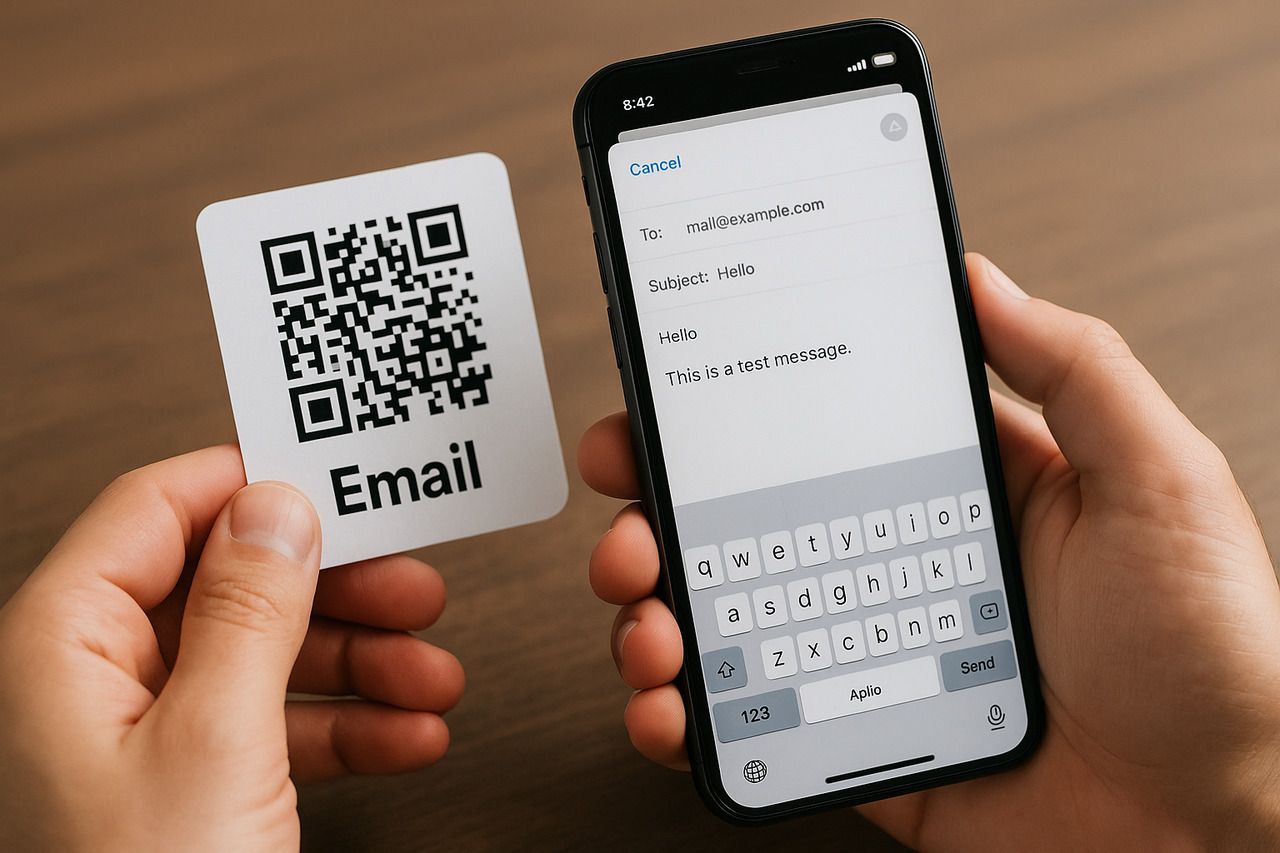
Why people use it:
- Removes typing friction on mobile
- Prevents mis-typed addresses
- Encourages messages with the right context ("Order #1234 – Return Request")
- Works on packaging, receipts, flyers, booths, menus, classrooms, and signage
Email QR vs. Other QR Types
Email QR codes fill a specific niche. Here's how they compare to the other common QR types:
| Goal | Best QR Type | What Happens on Scan |
| Get a ready-to-send email | Email QR | Opens mail app with prefilled draft |
| Send people to a webpage | URL QR | Opens browser (needs internet) |
| Collect SMS opt-ins or feedback | SMS QR | Opens Messages with prefill |
| Trigger a phone call | Phone QR | Opens dialer with number ready |
| Share full contact card | vCard QR | Opens "Add to Contacts" |
The key advantage of email QR over SMS QR: emails can be longer, support attachments, and don't cost the sender anything. The tradeoff is that email response rates are lower than SMS, so pick the format based on what kind of reply you actually need.
Email QR Code vs. Contact Form
Both collect messages from users, but they work differently and suit different situations.
Email QR codes work offline, require no internet to open the compose screen, and let the user write from their own email app. The message sits in their sent folder for reference. They're ideal for physical touchpoints — packaging, signage, printed materials — where asking someone to visit a webpage adds friction.
Contact forms require a webpage and internet access, but they give you structured data (dropdowns, required fields, file uploads) and can route submissions to a CRM automatically. They're better when you need specific data in a specific format.
My rule: if the interaction starts in the physical world (someone's holding a product, standing at a sign, sitting at a table), use an email QR. If they're already on your website, use a form.
How Email QR Codes Work?
Under the hood, an email QR is simply a mailto URI. Here's the basic pattern:
mailto:hello@yourbrand.com
Add a subject and body (URL-encoded):
mailto:hello@yourbrand.com?subject=Order%20Question&body=Hi%20team%2C%0AHere%E2%80%99s%20my%20order%20numbe r%3A%201234.
Add CC and BCC if needed:
mailto:hello@yourbrand.com?cc=support@yourbrand.com&bcc=ops@yourbrand.com&subject=Quote%20Request&body=Plea se%20send%20pricing.
Spaces become %20, line breaks become %0A, and special characters are encoded so the mail app reads them correctly. Most generators handle this encoding automatically — you just type normally and the tool converts it.
Mailto URI Parameter Reference
Here's the full set of parameters you can use in a mailto link:
| Parameter | What It Does | Example |
mailto: | Primary recipient (To field) | mailto:hello@brand.com |
?subject= | Prefills the subject line | ?subject=Order%20Question |
&body= | Prefills the message body | &body=Hi%20team%2C |
&cc= | Adds CC recipients | &cc=manager@brand.com |
&bcc= | Adds BCC recipients (hidden) | &bcc=archive@brand.com |
You can chain multiple CC or BCC addresses with commas: &cc=one@brand.com,two@brand.com. This is useful for routing emails to both a support inbox and a team lead simultaneously.
Static vs. Dynamic Email QR: Which Should You Use?
- Static Email QR (recommended for email): The
mailto:is encoded directly into the QR. It's reliable, opens instantly, and doesn't rely on internet access. You can't change it after printing. - Dynamic link to mailto (optional): The QR points to a short URL that redirects to your mailto (or a micro-landing page). This type of dynamic QR code allows scan analytics and post-print edits, but relies on connectivity for the redirect. Some older scanners might not auto-handoff to the mail app after a redirect.
My rule: If your top priority is frictionless email compose, go static. If you truly need scan tracking or post-print updates, use a dynamic bridge and test thoroughly on multiple devices.
| Feature | Static Email QR | Dynamic Email QR |
| Opens mail app directly | Yes (instant) | After redirect (slight delay) |
| Works offline | Yes | Needs internet for redirect |
| Edit after printing | No | Yes |
| Scan analytics | No | Yes (time, location, device) |
| Compatibility | Universal | Rare issues with older scanners |
| Cost | Free | Paid tiers common |
For most email QR use cases — support lines, feedback collection, contact cards — static is the better choice. The direct mailto handoff is faster and works everywhere, which matters more than analytics for this format.
How to Create an Email QR Code (Step-by-Step)
I use QR Code Dynamic because it's fast, design-flexible, and lets me export crisp print files. Here's the flow I follow.
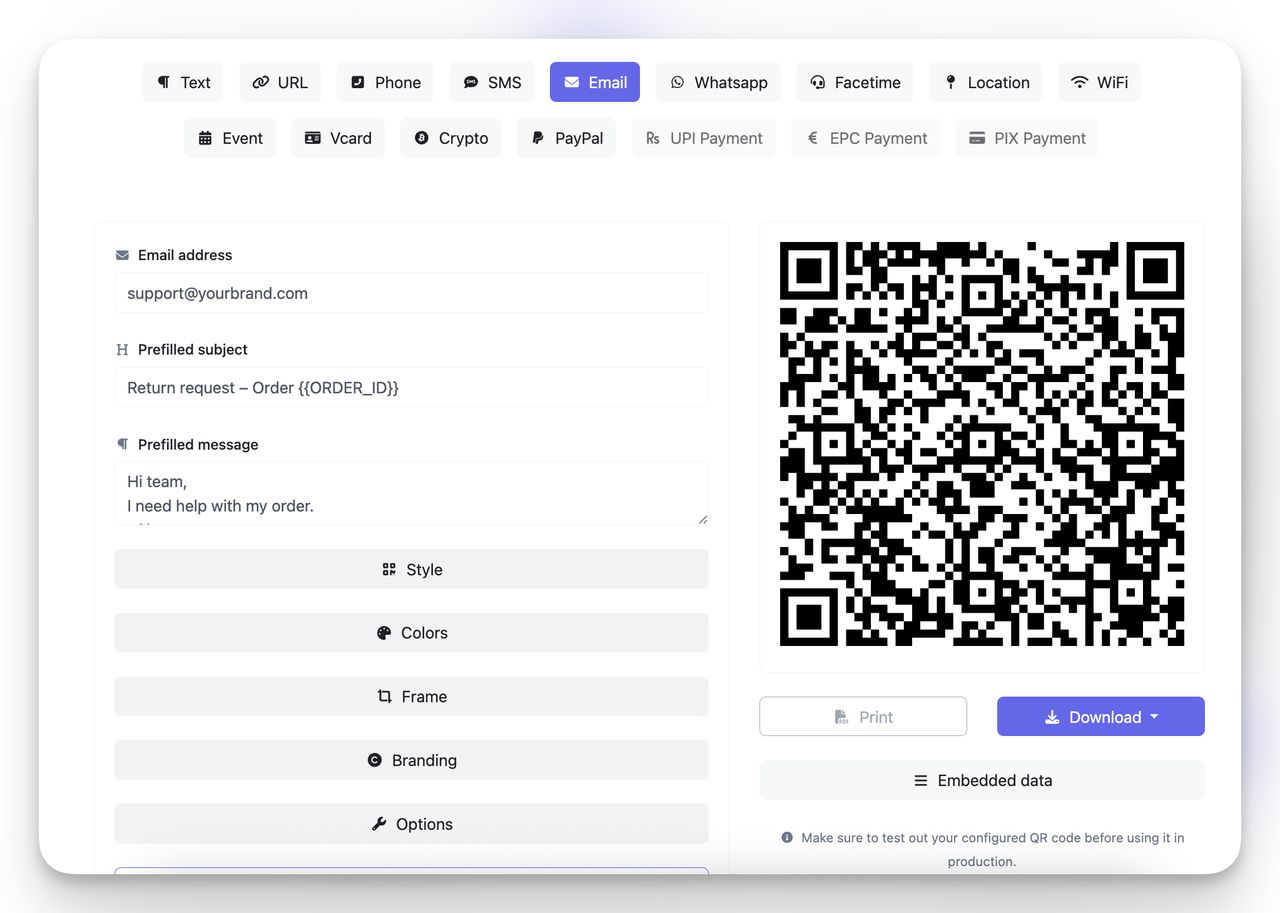
Step 1: Choose "Email" Type
Open the generator and select Email. You'll see fields for Email address, Prefilled subject, and Prefilled message.

Step 2: Fill Out the Fields
- To:
support@yourbrand.com(or a role alias likehello@for continuity if team members change) - Subject: e.g.,
Return request – Order {{ORDER_ID}} - Body: Add helpful prompts or placeholders the user can keep or edit.
Example body template:
"Hi team,
I need help with my order.
- Name:
- Order number:
- Issue:
- Preferred resolution:
Thanks!"
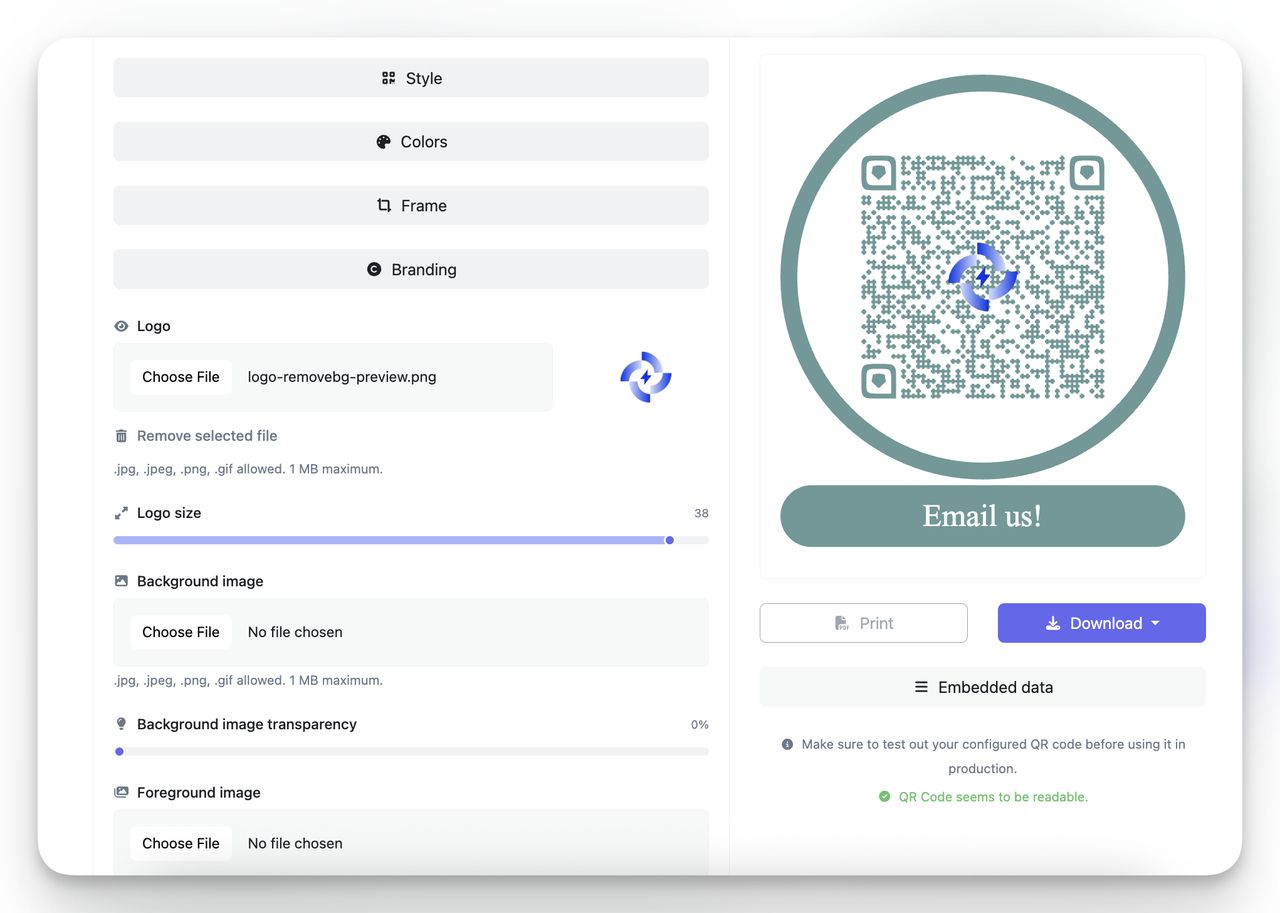
Step 3: Customize the Design
- High contrast (dark foreground on light background)
- Add a frame with a CTA like "Email us" or "Send feedback"
- Corner styles / eyes for brand fit
- Logo (keep under ~30% of code area)
Step 4: Download a High-Quality File
- PNG for screens
- SVG/EPS for print and packaging (infinitely scalable)
- PDF if your print vendor prefers it
Step 5: Test It — Always
- iPhone (Apple Mail + Gmail)
- Android (Gmail + OEM mail apps)
- Scan in bright and low light
- Try angled scans and from the expected distance
If the draft doesn't open instantly, your generator may have produced a URL redirect instead of a pure mailto. Use static mailto for guaranteed "scan → compose" behavior.
Best Practices for Email QR Codes
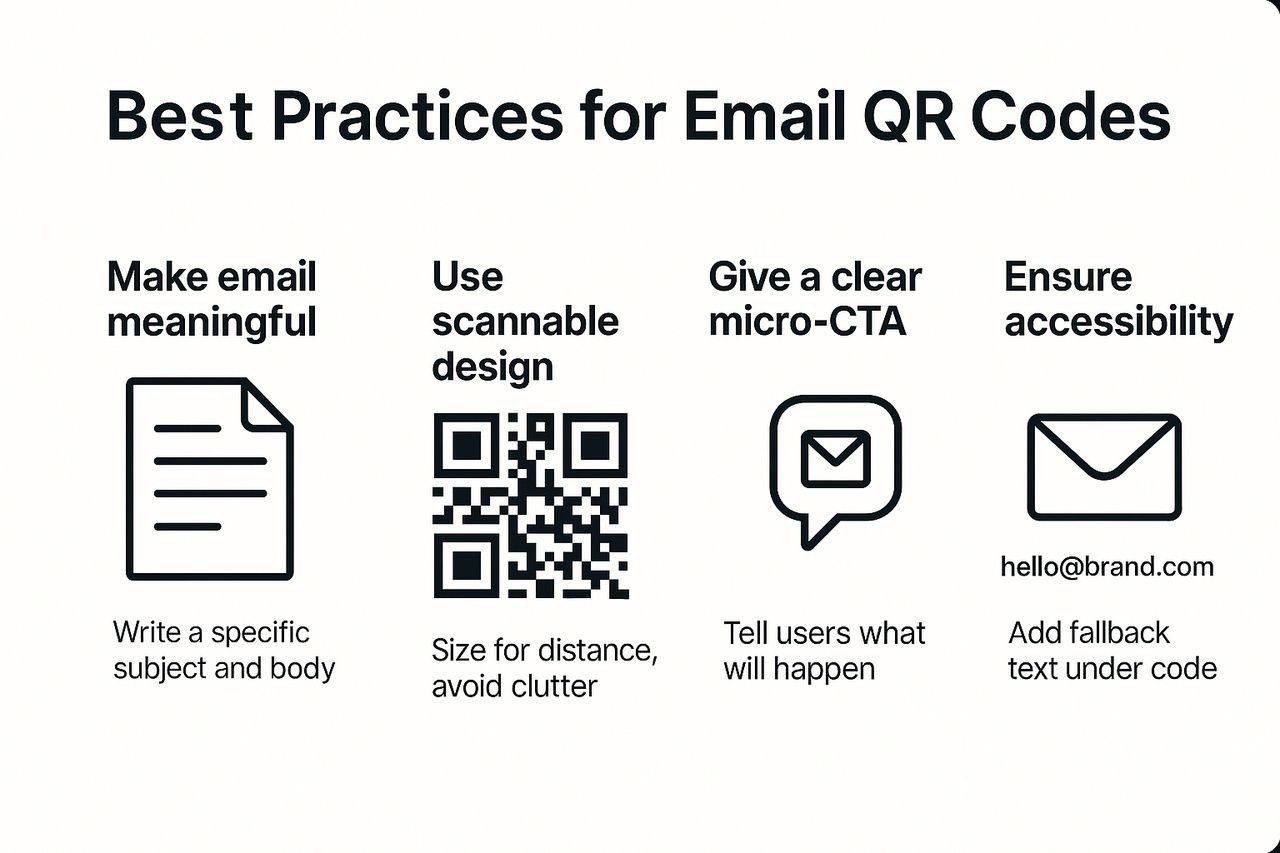
Make the Email Meaningful by Default
A good subject and body reduce back-and-forth and make triage faster on your end.
Subject starters:
Booking inquiry – {{DATE}}Return request – Order {{NUMBER}}Partnership proposal – {{COMPANY}}Maintenance issue – Unit {{ID}}
Body starter:
"Hi team,
I'm reaching out about:
- Topic:
- Reference (order/room/table ID):
- Details:
- Photos attached? (Y/N)
Thanks!"
Use Readable, Scannable Design
- Keep quiet zone (clear margin) of at least 4 modules
- Avoid inverted colors (white code on dark) unless you print at very high resolution
- Do not put dense textures behind the code
- If you add a logo, keep it small and centered
Size for Distance
The rule: minimum QR size = scanning distance / 10.
| Scanning Distance | Minimum QR Size | Typical Placement |
| 15 cm (6 in) | 1.5 cm (0.6 in) | Product labels, receipts |
| 30 cm (12 in) | 3 cm (1.2 in) | Business cards, menus, brochures |
| 1 m (3.3 ft) | 10 cm (4 in) | Posters, booth signage, table tents |
| 3 m (10 ft) | 30 cm (12 in) | Storefront windows, banners |
Longer mailto strings (with subject, body, CC) produce denser codes that need to be printed larger than simple ones. If your QR looks very dense in the preview, shorten the prefilled body text.
Place It Where People Act
- Near cash wrap: "Email receipt" or "Email us your feedback"
- On packaging flaps: "Questions? Email support"
- At booths: "Contact sales (instant draft)"
- On menus/table tents: "Allergen questions? Email the chef"
Give a Clear Micro-CTA
Frames like "Email support", "Send feedback", "Report an issue", or "Apply by email" tell users what will happen before they scan.
Don't Embed Secrets
Never put passwords, one-time codes, or personal data in a mailto body that's printed broadly. Anyone who scans the code sees the full draft content.
Accessibility & Fallback
- Add a small line of text under the QR: Email: hello@brand.com
- Provide alt text descriptions when embedding the QR image online
- Instruct staff to say: "Scan the QR to email us; if it doesn't open, type hello@brand.com"
Not everyone can scan. Older phones, broken cameras, and vision impairments all exist. A plain-text fallback costs nothing and catches the users QR codes miss.
Real-World Email QR Code Use Cases
Retail & E-commerce
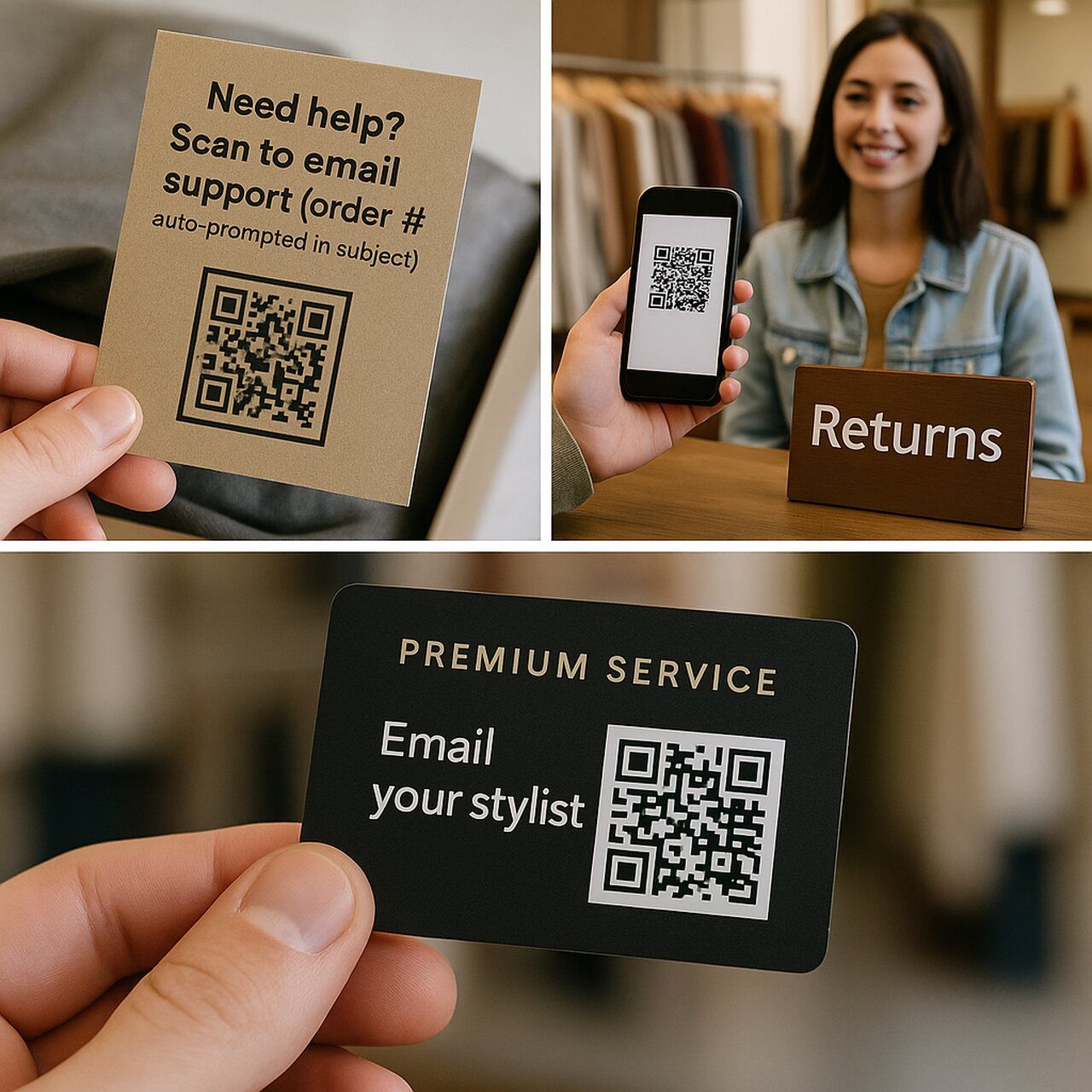
- Packaging insert: "Need help? Scan to email support (order # auto-prompted in subject)."
- Returns desk: Email-prefilled QR to reduce line time and keep records tidy.
- Premium service: VIP cards with "Email your stylist" QR.
Related guide: QR Code Solutions for Retail
Restaurants, Cafés, Hospitality
- Menu footer: "Allergen questions? Email the chef" (pre-filled template).
- Rooms & rentals: "Report an issue" stickers — maintenance gets complete info the first time.
- Events/banquets: "Setup requests? Email coordinator."
Related guide: Top 16 QR Code Ideas for Restaurants & Bonus Tips
Education & Nonprofits
- Field trips: Parents scan to email consent or questions.
- Library shelves: "Can't find a copy? Email a hold request" with prefilled fields.
- Fundraisers: "Sponsor us — email the organizer."
- Student services: "Request transcript" or "Schedule advising" with the department email and student ID placeholder in the body.
Related guide: How to Use QR Codes for Non-Profits
B2B & Events
- Booths: "Contact sales" with structured body prompts for speed.
- Workshops: "Email slides/resources" to attendees while interest is hot.
- Name badges: Private email QR for networking follow-ups.
Related guide: Event QR code generator
Healthcare & Services
- Waiting rooms: "Reschedule/cancel via email" (no PHI in body; point to a secure portal for sensitive info).
- Home services: Techs leave "Email invoice copy" QR on the job summary sheet.
- Insurance: "File a claim" with policy number placeholder in the subject line — agents get structured requests instead of freeform voicemails.
Related guide: QR Code for Doctors: Boost Communication & Efficiency
HR & Internal Operations
- IT help desks: Print codes on shared printers and conference room AV equipment — "Equipment issue? Email IT" with room number and device type prefilled.
- Employee feedback: Place codes in break rooms or near exit doors — "Share feedback with HR" with an anonymous alias as the recipient.
- Onboarding packets: New hires scan to email their manager with "First week questions" as the subject.
Printing & Material Tips
- Paper: Uncoated or matte reduces glare.
- Labels: Choose high-contrast stocks; avoid metallic inks over the QR.
- Signage: If outdoors, laminate or UV-coat; keep the code away from folds or rounded corners.
- Clothing: Embroidered QR rarely scans; use woven or high-res print patches.
- Curved surfaces: Increase size and reduce density (shorter mailto, fewer parameters).
Related guide: Printing QR Codes: The Complete Guide
Tracking Options for Email QR Codes
Email QR codes are about instant compose, which doesn't inherently create analytics. If you need tracking, here are three non-intrusive approaches:
1. Alias tracking. Use a unique recipient for each placement: hello+menu@brand.com, hello+booth@brand.com. Your email platform can filter and count by alias. Gmail, Outlook, and most business email providers support the +alias format.
2. Tokenized subject. Include a source token in the subject: Support – [MENU_QR] or Support – [BOOTH_QR]. Your helpdesk can report volumes by token. This works with any email system and doesn't require technical setup.
3. Dynamic bridge. QR → short URL (tracked) → immediately redirects to a mailto link. You'll see scan counts and device data in your QR dashboard. Test thoroughly on both iOS and Android to make sure the handoff to the mail app is seamless. Add a 1-second instruction screen as a fallback if some scanners block the redirect.
For most use cases, alias tracking (option 1) gives you enough data without adding any friction to the user experience. Reserve the dynamic bridge for high-stakes campaigns where scan-level analytics justify the added complexity.
Privacy note: Keep it straightforward. You're inviting people to email you, not tracking them across the web.
Email QR Code Compliance & Etiquette
- User intent: Email QR is a pull channel — the user initiates. Don't misuse it for unsolicited outreach.
- CAN-SPAM / consent: When responses join a marketing list, state this explicitly near the QR. A line like "By emailing us, you agree to receive our newsletter. Unsubscribe anytime." is enough.
- GDPR/CCPA: Avoid requesting sensitive personal data in the prefilled body. Point to a secure portal if you need health records, financial information, or government IDs.
- Retention: If you BCC an archive address, ensure your data retention policy is documented and accessible.
- Transparency: If the prefilled body includes a hidden BCC (for your records), mention it near the code. Users should know who receives their message.
Troubleshooting Email QR Codes
- Nothing happens after scanning: The QR might be a URL redirect that your camera preview opened inline instead of handing off to the mail app. Use pure mailto (static) or tell users to tap the banner notification to open their mail client.
- Opens the wrong email app: Users choose their own defaults. That's normal. The draft will still be created — it just opens in whatever app they've set as their default mail client.
- Weird characters in the message: The body wasn't URL-encoded properly. Use your generator's built-in encoding or run the text through a URL encoder before pasting it into a mailto string manually.
- Desktop users say "it didn't work": Many desktop webcam-based scanners don't handle mailto links well. Provide the plain email address under the QR so people can type it manually.
- Subject or body is blank on scan: Some mail apps strip parameters from mailto links that exceed a certain length. Shorten your prefilled text and test again. If the problem persists, remove the body and keep only the subject — it's better to have a correctly addressed email with no body than a failed scan.
Subject Lines & Message Starters for Email QR Codes
Customer support
Support request – Order {{NUMBER}}Warranty question – Product {{SKU}}Exchange inquiry – Size {{SIZE}}
Sales & partnerships
Partnership inquiry – {{COMPANY}}Demo request – {{PRODUCT}}Pricing question – {{USE_CASE}}
Events
RSVP update – {{EVENT_NAME}}Vendor inquiry – {{EVENT_DATE}}Sponsorship interest – {{TIER}}
Education
Absence note – {{Student}}Parent question – {{Class/Period}}Conference scheduling – {{Teacher}}
Message starter (paste into body field):
"Hi team,
Context:
Goal:
Deadline:
Attachments included? (Y/N)
Thanks!"
The {{PLACEHOLDER}} pattern tells the user to fill in their own details. It's better than leaving a blank space because it's obvious what goes where. Keep placeholders in uppercase so they stand out in the draft.
Why Use QR Code Dynamic as Your Email QR Code Generator
- Frictionless "Email" type: Built-in fields for To, Subject, Body, CC/BCC
- Design controls: Colors, corner shapes, frames with "Email us" CTA, and logo overlay
- Print-perfect exports: SVG, EPS, PDF, PNG
- Fast testing: Live preview + instant scanning
- Truly free for static email QRs: No forced signup for basic use
Create your email QR code now — it takes about 60 seconds to go from idea to a tested, print-ready code.
FAQ About Email QR Codes
Can I make a QR code for email?
Yes. You can create a QR code that opens a new email draft with your chosen recipient, subject, and message already filled in. Use a QR code generator that supports the "Email" type — tools like QR Code Dynamic make this quick and straightforward.
How do I create a Gmail QR code?
A Gmail QR code is simply an email QR code. When scanned on a phone with Gmail installed, it opens a new draft in Gmail. Use a generator, set your fields (To, Subject, Body), and test it on Gmail for both iOS and Android to make sure it works.
How do I create a mailto link?
A mailto link is the backbone of an email QR code. The basic format is:
mailto:someone@example.com
You can add a subject and body like this:
mailto:someone@example.com?subject=Hello&body=Hi%20there
Encode spaces as %20 and line breaks as %0A. Generators like QRCodeDynamic handle this encoding automatically.
Do email QR codes work offline?
Yes, if you use a static mailto QR code. The mailto information is stored directly in the QR pattern, so no internet connection is needed — the scan opens the device's email app directly. A dynamic QR code may need internet access since it goes through a redirect first.
Is there a character limit for the email QR code?
There's no strict character limit for the mailto string itself, but two practical constraints apply. First, longer text creates a denser QR pattern that's harder to scan at small print sizes. Second, some mail clients truncate or strip parameters from very long mailto links. Keep the combined subject and body under 200–300 characters for reliable cross-device behavior.
Can I add CC and BCC recipients?
Yes. The mailto format supports &cc= and &bcc= parameters. You can add multiple addresses separated by commas. This is useful for routing emails to a shared inbox and a manager simultaneously, or BCCing an archive address for record-keeping. QRCodeDynamic has dedicated CC/BCC fields in the generator.
What if the user has no email app installed?
On most smartphones, a default email client is pre-installed (Mail on iOS, Gmail on Android). If the user has removed all mail apps, the scan will fail silently or show a "no app found" prompt. This is rare, but it's another reason to always include a plain-text email address as a fallback near the QR code.
Will the email send automatically when scanned?
No. The scan only opens a draft — the user must tap Send. This is by design. Auto-sending emails without user action would be a security risk and is not supported by any mobile OS. The user always has a chance to review, edit, or cancel the email before it goes out.