Location QR code generator
Generate easy & customizable Location QR codes in seconds.
Location QR Code Generator: Share Maps, Coordinates & Directions
Whether you're guiding guests to a wedding venue, helping customers find your store, or setting up meeting points for field teams — a Location QR Code turns coordinates into a one-scan solution.
I've used these on everything from event invitations to construction site briefings. When someone needs to get somewhere without fumbling with addresses or searching map apps, a location QR code removes the guesswork entirely.
In this guide, I'll show you how location QR codes work, how to create one in seconds with QRCodeDynamic, and where they're most useful for local businesses, event planners, field teams, and anyone sharing a physical location.
What Is a Location QR Code?
A location QR code is a scannable code that encodes latitude and longitude coordinates. When scanned, it opens the user's default maps app (Google Maps, Apple Maps, Waze, etc.) with a pin dropped exactly at the location you specified.
Think of it as a shortcut to directions. Instead of typing or searching for an address, the QR code shows the user exactly where to go — on mobile, tablet, or desktop.
If you've ever scanned a code outside a shop that opens Google Maps, or received a printed event invite with a "Scan for Location" badge — that's a location QR code in action.
Location QR Code vs. Other QR Types
Location QR codes serve a specific purpose: getting someone to a physical place. Here's how they compare to other common formats:
| QR Code Type | What Happens on Scan | Requires Internet? | Best For |
| Location QR | Opens maps app with pin at coordinates | Yes | Directions, meetup points, venue navigation |
| URL QR | Opens a webpage | Yes | Landing pages, forms, videos |
| Text QR | Displays plain text on screen | No | Codes, instructions, Wi-Fi passwords |
| Phone QR | Opens dialer with number ready to call | No | Voice calls, hotlines, support |
| Event QR | Adds event to calendar | No | Meetings, conferences, reminders |
You could also encode a Google Maps URL into a URL QR code, but a dedicated location QR code is cleaner — it encodes raw coordinates, so the user's phone opens whichever maps app they prefer rather than forcing a browser-based Google Maps view.
How Does a Location QR Code Work?
Behind the scenes, the process is straightforward:
- You enter a latitude and longitude pair (e.g.,
40.712776, -74.005974). - The generator encodes those coordinates into a QR pattern.
- When scanned, the code opens the device's default map app with a pinned marker at those coordinates.
- The user can then tap "Directions" or "Start Navigation" to get routing from their current position.
No URLs to remember. No searching for names or landmarks. The coordinates are baked into the code, so it works even for locations that don't have a formal street address — outdoor venues, parking lot entrances, trailheads, construction sites, delivery drop-off points.
What Gets Encoded
Most location QR codes use the geo: URI scheme:
geo:40.712776,-74.005974
Some generators encode a Google Maps URL instead:
https://maps.google.com/?q=40.712776,-74.005974
The geo: format is more universal — it lets the phone open whichever maps app the user prefers. The Google Maps URL forces the browser (or the Google Maps app if installed). QRCodeDynamic uses the approach that gives the broadest compatibility across iOS and Android.
How to Create a Location QR Code (Step-by-Step)
No design or technical skill needed. Here's the process using QRCodeDynamic:
Step 1: Find Your Coordinates
Before you open the generator, you need the latitude and longitude of your location. The easiest way:
- Open Google Maps on desktop
- Right-click on the exact spot
- Click the coordinates that appear at the top of the menu — they'll copy to your clipboard
Example: 40.7580, -73.9855 (Times Square, New York)
You can also get coordinates from Apple Maps (long-press on a location, tap the info panel) or from any GPS app on your phone.
Step 2: Enter Coordinates in the Generator
Go to QRCodeDynamic's Location Generator and paste your latitude and longitude. The system generates a preview of your QR code immediately.
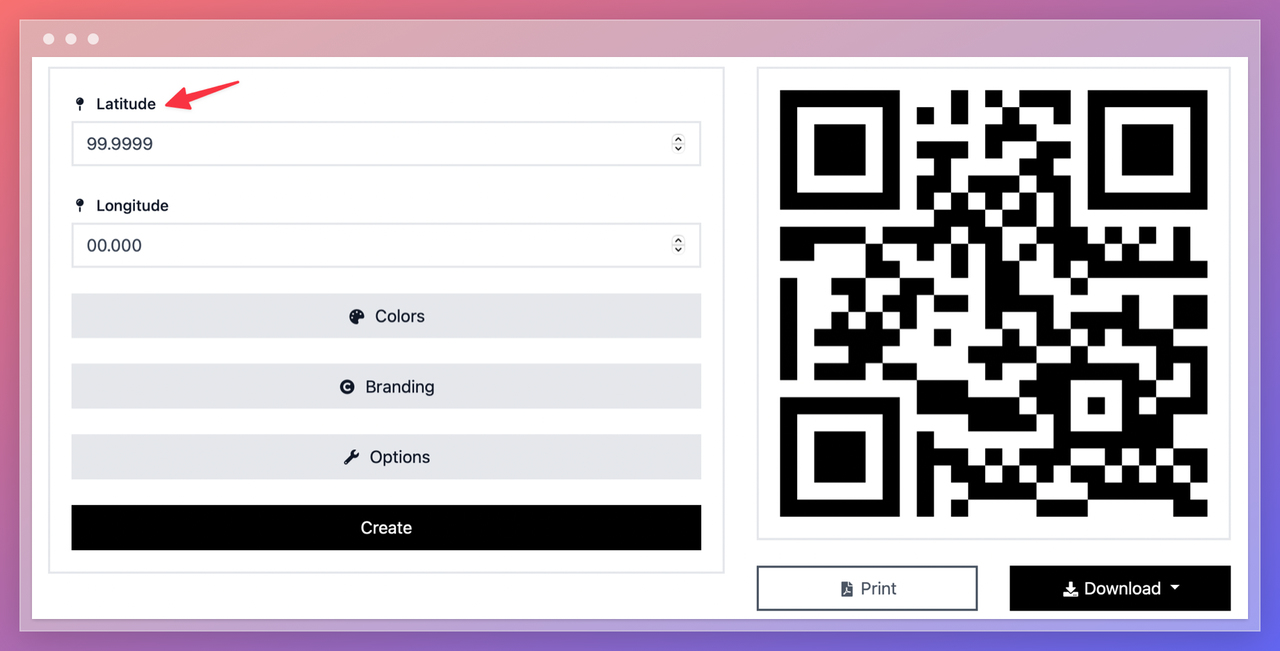
Double-check the coordinates by scanning the preview. A single transposed digit will drop the pin in the wrong place — and nobody will know until they're driving to the wrong location.
Step 3: Customize Your Design
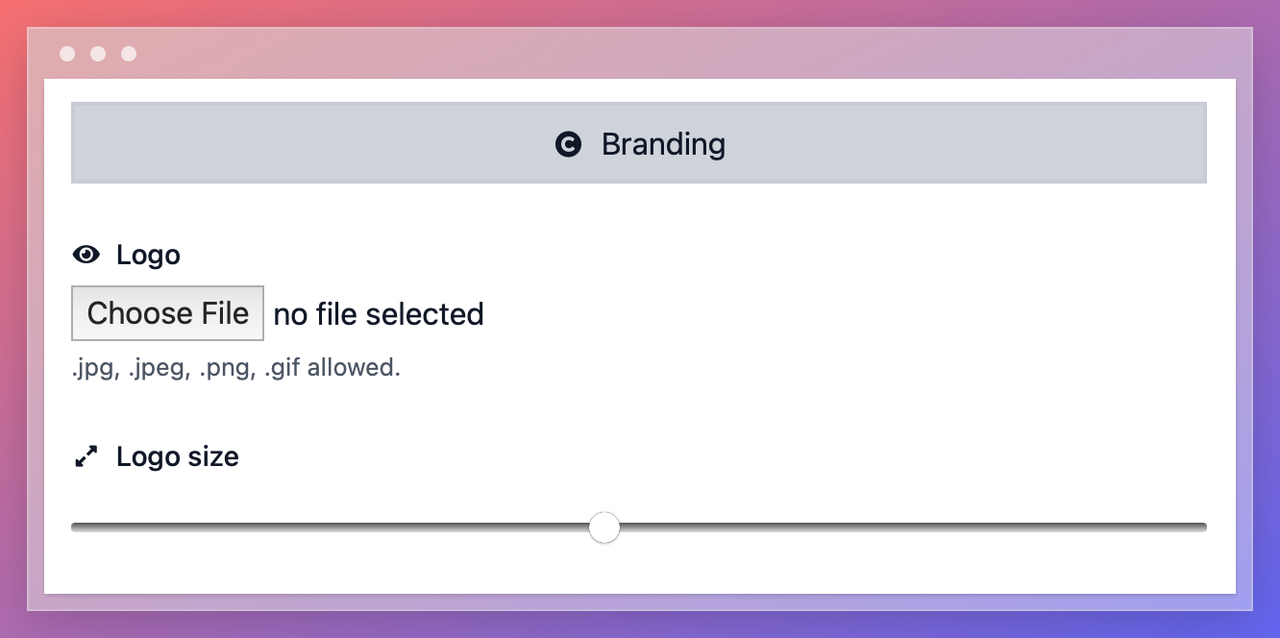
Make your QR code match your brand or stand out:
- Change foreground and background colors (dark on light for best results)
- Upload a logo (small, centered, under 30% of the code area)
- Adjust corner shapes and eye patterns for a branded look
High contrast is non-negotiable. A code that looks great but doesn't scan is useless.
Step 4: Download and Test
- Download as PNG for web and email
- Choose SVG or PDF for high-res print
- Scan with your phone before sharing — confirm the pin drops at the right spot
- Test on both iPhone (Apple Maps) and Android (Google Maps) to verify cross-platform behavior
Don't rely on the preview alone. Always scan your code from different phones and in different lighting conditions before printing.
Best Practices for Location QR Codes
Accuracy First
Use exact coordinates from Google Maps, not approximate addresses. Street addresses can resolve differently across map providers — the pin for "123 Main St" might land on the front door in Google Maps but the parking lot in Apple Maps. Coordinates eliminate that ambiguity.
For large venues, pin the coordinates at the entrance people should actually use, not the center of the building. A pin on the north entrance of a convention center is more useful than a pin in the middle of the building footprint.
Sizing for Print
| Scanning Distance | Minimum QR Size | Typical Placement |
| 15 cm (6 in) | 1.5 cm | Business cards, invitations |
| 30 cm (12 in) | 3 cm | Flyers, menus, brochures |
| 1 m (3.3 ft) | 10 cm | Posters, event signage |
| 3 m (10 ft) | 30 cm | Storefront windows, yard signs, banners |
The rule: minimum QR size = scanning distance / 10. For digital use, 180 x 180 px minimum.
Design Rules
- Contrast: Dark foreground on a light background. Avoid low-contrast pairs.
- Quiet zone: Leave a clear margin of at least 4 modules around the code.
- Logo: Keep it small and centered. Don't cover the three finder patterns (corner squares).
- CTA label: Always add text near the code — "Scan for Directions," "Find Us," or "Get Directions to [Venue Name]." Without a label, people won't know what the code does.
Static vs. Dynamic Location QR Codes
Static location QR codes encode the coordinates directly. Free, simple, and permanent — but you can't change the location after printing.
Dynamic location QR codes route through a redirect. You can update the coordinates later (useful for recurring events at different venues) and track scan data (time, device, location).
| Feature | Static | Dynamic |
| Edit after printing | No | Yes |
| Scan analytics | No | Yes (time, device, location) |
| Works offline (scan step) | Yes (maps app still needs internet) | Needs internet for redirect + maps |
| Cost | Free | Paid tiers common |
If your location is permanent (a store, office, or monument), static is fine. If you're printing codes for a recurring event series, a mobile pop-up, or a seasonal market that changes venues, use dynamic so you can update the coordinates without reprinting.
Use Cases for Location QR Codes
Local Businesses & Retail
Print location QR codes on shopfront signs, delivery flyers, business cards, and packaging. Customers scan at home and get turn-by-turn directions to your store. This is especially valuable for businesses in hard-to-find locations — basement shops, upper-floor offices, side-street entries, or venues inside larger complexes.
For businesses with multiple locations, print a different QR code for each branch. Dynamic codes let you track which locations generate the most scans.
Event & Wedding Planners
Embed location QR codes on invitations, save-the-dates, and event programs. Guests scan and get directions without texting the host for the address. For outdoor venues — parks, farms, beach spots — coordinates are far more reliable than a street address that maps apps may not recognize.
Multi-venue events (ceremony at one location, reception at another) benefit from two codes with clear labels: "Scan for Ceremony Directions" and "Scan for Reception Directions."
Real Estate & Rentals
Agents print location QR codes on property signage, brochures, and listing sheets. Prospective buyers or renters scan from the listing page and get routed directly to the property without typing an address. For new developments where the street address hasn't been officially registered yet, coordinates are the only reliable way to guide visitors.
Field Service & Logistics
Construction sites, delivery drop-off zones, utility access points, and service areas often don't have clean addresses. A location QR code on a work order or dispatch sheet gets field technicians to the exact spot. Logistics companies print them on shipping labels for last-mile delivery drivers navigating warehouse complexes or gated communities.
Tourism & Hospitality
Hotels print location QR codes on welcome packets, keycards, and concierge materials linking to nearby restaurants, attractions, or shuttle pickup points. Tour companies put them on printed itineraries so travelers can navigate between stops without the guide having to spell out every address.
Education & Campus Navigation
Universities and large corporate campuses print location QR codes on orientation materials, building directories, and event signage. New students or visitors scan to find the right building entrance, parking structure, or auditorium rather than wandering a sprawling campus.
Adding Context to Your Location QR Code
A raw pin on a map is useful but incomplete. Adding context around the QR code makes it more effective:
- Name the destination. "Scan for Directions to Oak Hall, Building C, North Entrance" is far more helpful than "Scan for Directions."
- Include parking info. "Free parking in Lot B — scan for directions to the lot entrance." People need to know where to park, not just where the building is.
- Add a landmark reference. "Located behind the Shell station on 5th Ave" next to the QR code gives people a backup if scanning fails or they want to verify they're heading to the right place.
- Note access restrictions. "Gate code: 4521. Scan for directions to the gate." Coordinates alone don't get you through a locked gate.
The QR code handles navigation. The surrounding text handles everything the map can't show.
Offline Considerations for Location QR Codes
Location QR codes require internet access to load the map and get directions. The scan itself works offline (the camera reads the coordinates from the pattern), but the maps app needs data or Wi-Fi to render the map and calculate a route.
If your audience will be in areas with poor connectivity (remote venues, underground parking, rural event sites), consider these workarounds:
- Print the coordinates and a landmark description alongside the QR code. Even without internet, someone can note the coordinates and use them later when they have signal.
- Suggest offline map downloads. A note like "Download the area in Google Maps for offline use before arriving" helps attendees prepare.
- Provide a written address as fallback. If the venue has a street address, print it alongside the QR code. The QR code is the primary tool; the address is the backup.
Generate Your Free Location QR Code Now
Creating and customizing your location QR code is instant and requires no account. Visit QRCodeDynamic's Location QR Code Generator, drop your coordinates, customize the design, and get a ready-to-scan code in under 60 seconds.
- No sign-up needed for static codes
- Customize with logo, colors, and CTA frames
- Download in PNG, SVG, PDF, or JPG
- Instant preview + scan test
FAQ About Location QR Codes
How do I find my latitude and longitude?
Open Google Maps on desktop, right-click on the exact spot, and click the coordinates that appear at the top of the menu — they'll copy to your clipboard. On mobile, long-press on a spot in Google Maps and the coordinates appear in the search bar or info panel. You can also use Apple Maps, GPS apps, or search "coordinates of [place name]" in any search engine.
Can I use a location QR code without internet?
The scan works offline — your camera reads the pattern locally. But the maps app needs an internet connection to load the map and calculate directions. If you're in an area with poor signal, download the map area for offline use in Google Maps beforehand. As a fallback, print the street address or a landmark reference next to the QR code.
Can I edit a location QR code after printing?
Not if it's a static code — the coordinates are permanently encoded. If you use a dynamic code, you can log in and update the coordinates any time. The printed code stays the same, but the destination changes. This is ideal for recurring events at different venues or businesses that relocate.
What maps apps support location QR codes?
Most phones open location QR codes in their default maps app. On Android, that's usually Google Maps. On iOS, it's Apple Maps (though users who've set Google Maps as default will see it open there). Waze, HERE Maps, and other navigation apps can also handle the geo: URI if set as default.
Can I encode a specific address instead of coordinates?
A dedicated location QR code uses coordinates, not addresses. If you want to encode a street address, use a URL QR code with a Google Maps search link like https://maps.google.com/?q=123+Main+St+New+York. The tradeoff: address-based links depend on how the maps provider geocodes that address, which can vary. Coordinates are more precise.
Can I add a custom label to the map pin?
The geo: URI scheme doesn't support custom pin labels — it just drops a pin at the coordinates. If you need a labeled pin (e.g., "North Entrance — Check In Here"), encode a Google Maps URL with a query parameter instead: https://maps.google.com/?q=40.7580,-73.9855(North+Entrance). The label appears on the map in Google Maps, though behavior varies by app.
How accurate are location QR codes?
As accurate as the coordinates you enter. GPS coordinates can be precise to within a few meters. The QR code doesn't degrade the accuracy — it encodes exactly what you provide. The common accuracy issue is human error: transposing digits, rounding coordinates, or pinning the wrong spot on the map. Always scan and verify the pin location before printing.
Can I track how many people scanned my location QR code?
With a static code, no — the coordinates are encoded directly with no tracking layer. With a dynamic code, yes — each scan hits a redirect first, giving you data on scan count, device, location, and time in your QRCodeDynamic dashboard. This is useful for measuring how many event attendees actually used the QR code for directions.