Vcard QR code generator
Generate easy & customizable Vcard QR codes in seconds.
vCard QR Code Generator: Share Contact Info with a Single Scan
Business cards get lost. Emails go to spam. But a vCard QR code ensures your contact information lands exactly where it belongs — your recipient's phone address book.
Whether you're networking at events, onboarding clients, or upgrading your print collateral, vCard QR codes make it frictionless to save and share contact info in seconds. I've put them on business cards, conference badges, email signatures, and even office door signs — and every time, the result is the same: fewer lost contacts, faster follow-ups.
In this guide, I'll show you what a vCard QR code is, how to generate one step-by-step, and how to use it across real-world applications.
What Is a vCard QR Code?
A vCard QR code stores your contact details — name, phone, email, company, job title, website, and more — in a format that phones can instantly save as a contact. Scan it, and the information auto-populates into the user's address book. No typing, no confusion, no missed connections.
The vCard format (.vcf) is a universal standard supported by every major phone OS. When someone scans the code, their phone recognizes the data and prompts them to save a new contact with all the fields pre-filled.
A vCard QR code works offline — all the contact info is stored in the QR pattern itself. No internet connection needed to scan and save.
What Gets Encoded in a vCard QR Code
Here's the full set of fields you can include:
| Field | What It Does | Example |
| First & Last Name | Contact name in the address book | Jane Smith |
| Phone Number(s) | One or more numbers with labels | +1 415-555-2671 (Work) |
| Email(s) | One or more email addresses | [email protected] |
| Job Title | Professional role | Head of Sales |
| Company | Organization name | Acme Corp |
| Website URL | Link that appears in the contact card | https://acme.com |
| Street Address | Full address (street, city, ZIP, country) | 123 Main St, New York, NY 10001 |
| Social Profiles | LinkedIn, Instagram, X, etc. | linkedin.com/in/janesmith |
| Birthday | Date saved with the contact | March 15, 1990 |
| Note | Free-text field for context | "Best time to call: 10am–4pm EST" |
You don't have to fill every field. A minimal vCard with just name, phone, and email is perfectly valid. But the more relevant fields you include, the more useful the saved contact becomes for the person scanning.
How to Create a vCard QR Code (Step-by-Step)
Here's the process using QRCodeDynamic. It takes under two minutes.
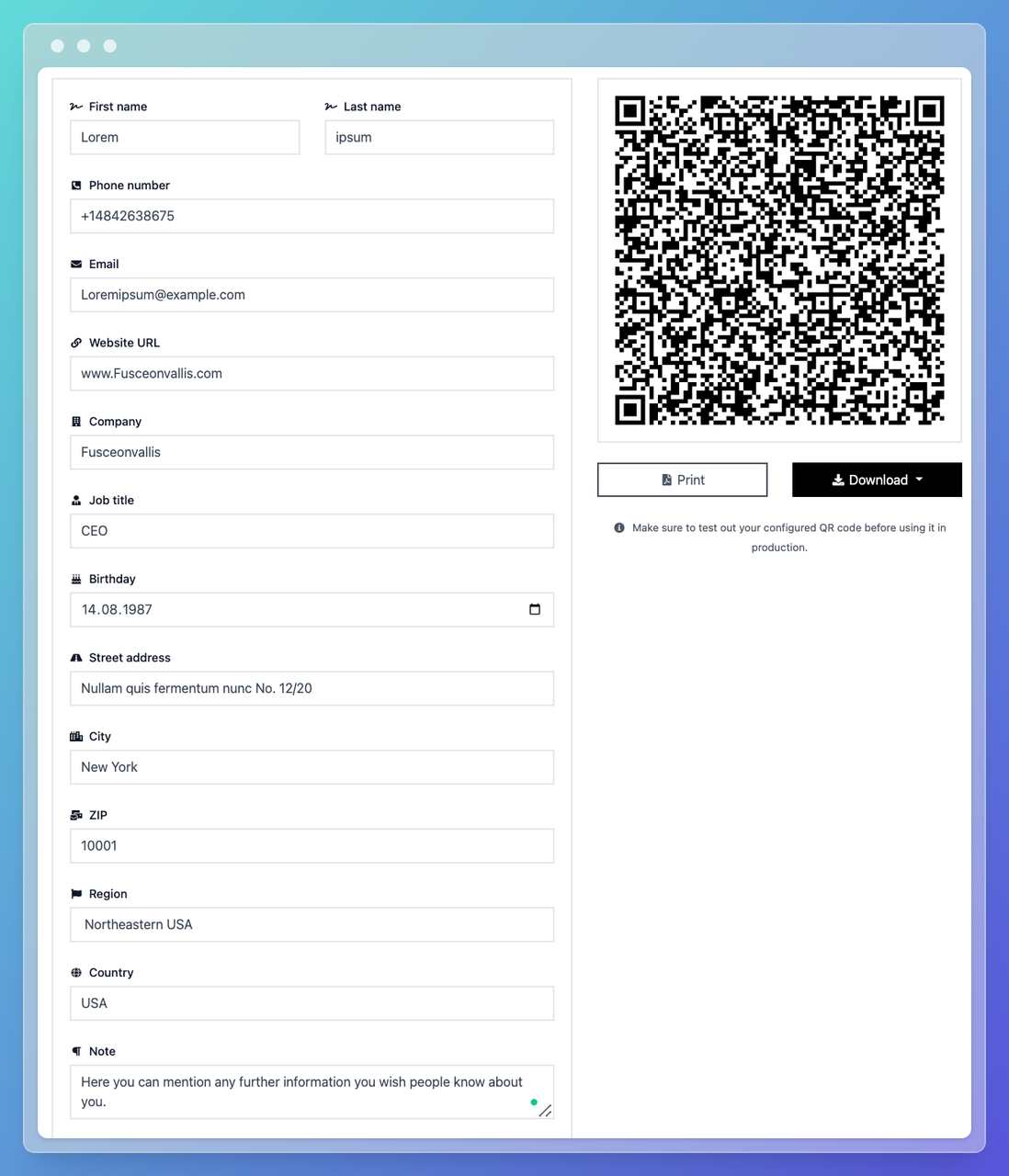
Step 1: Fill in Your Contact Info
Open the generator and select vCard from the QR type list. Fill in the fields you want to include. Recommended fields:
- First and last name
- Phone number (with country code)
- Email address
- Job title
- Company name
Optional but valuable: website URL, street address, social profiles (LinkedIn, Instagram), birthday, and a note field for context like "Best time to call: 10am–4pm."
Step 2: Add Notes and Social Profiles
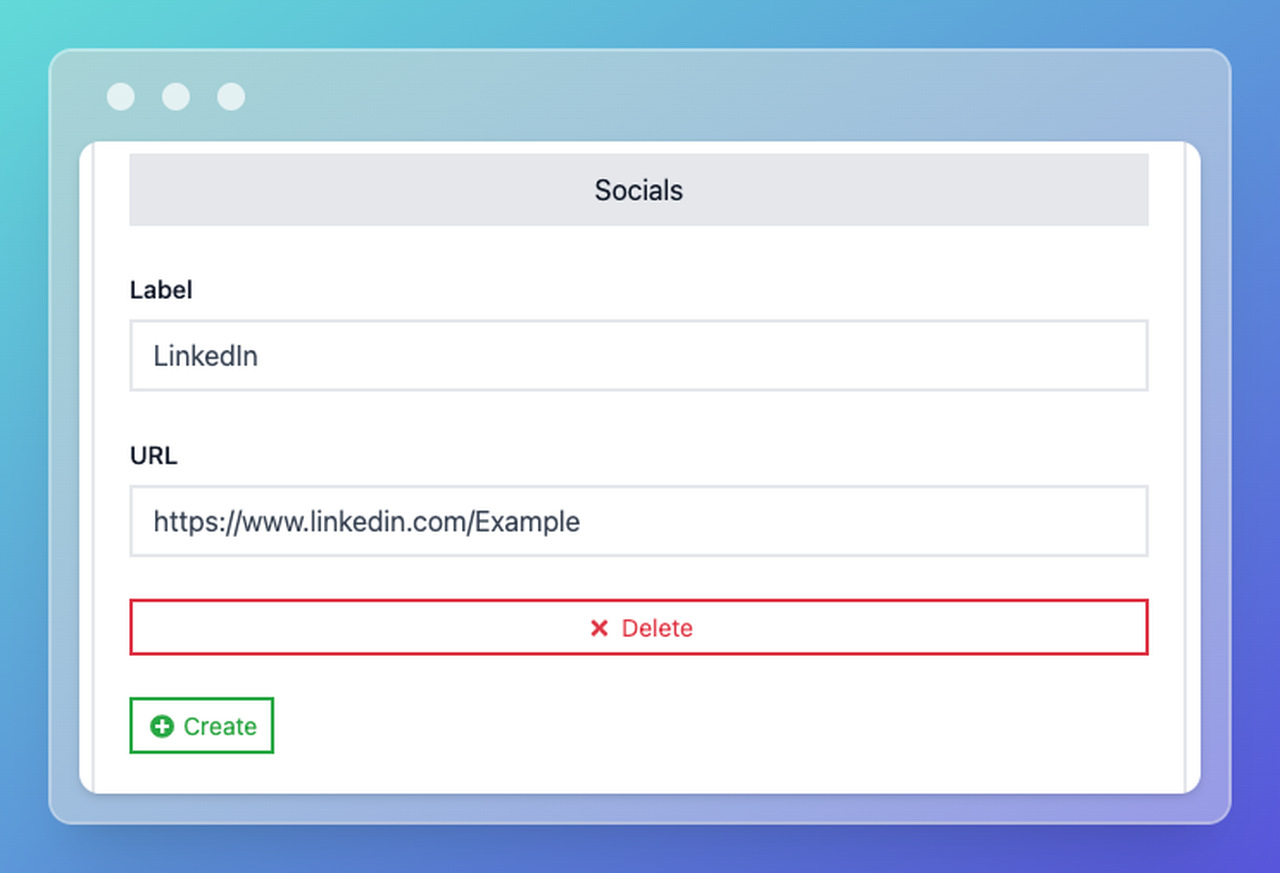
Use the Note field for helpful context — office hours, preferred communication method, or a short intro. Add social media profiles (LinkedIn, X, Instagram, portfolio URL) so people can follow or connect with you on multiple channels.
Step 3: Customize the Design
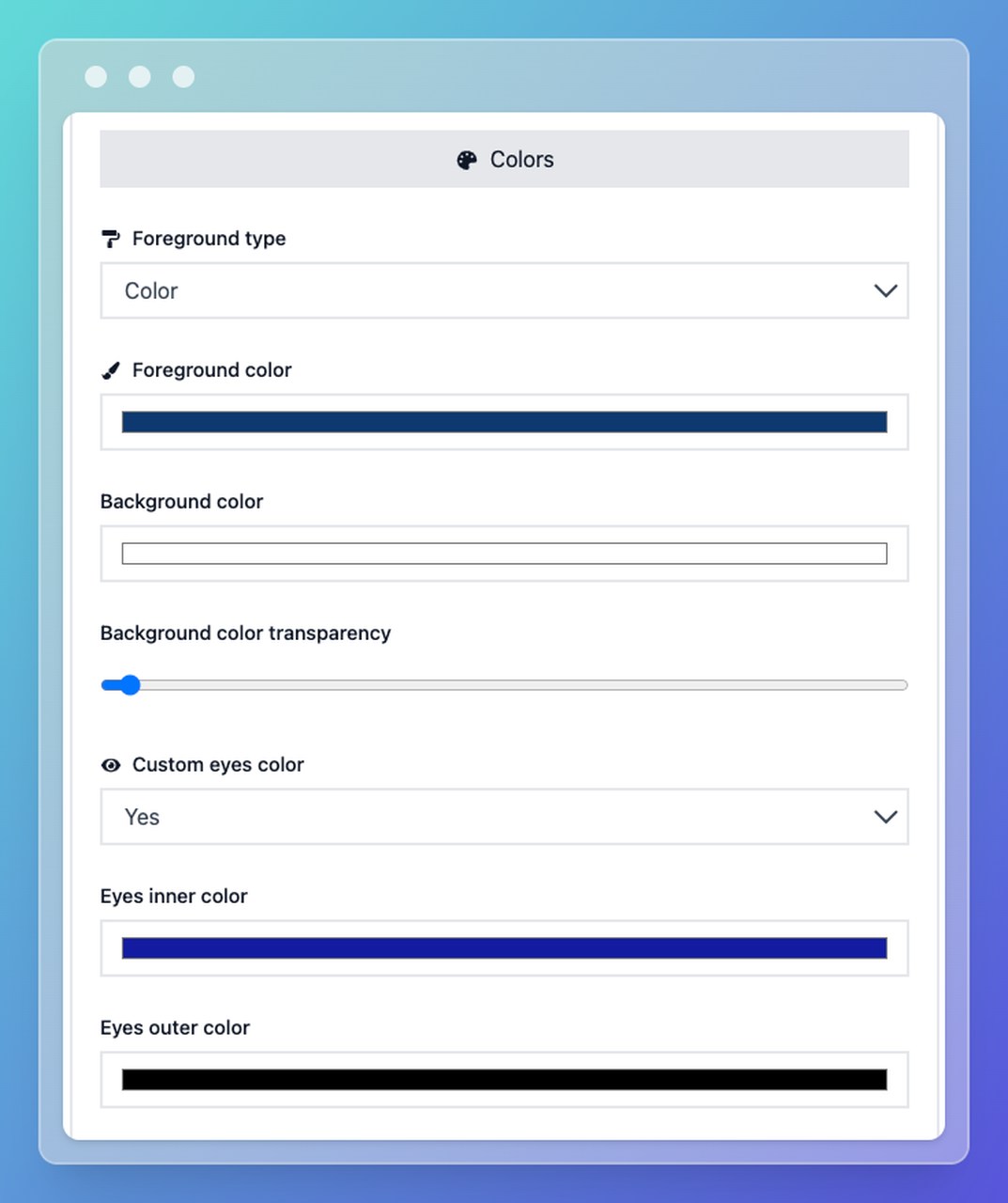
Make the code match your brand:
- Choose brand colors (dark foreground on light background for best scanning)
- Upload your logo (small, centered, under 30% of code area)
- Pick a CTA for the QR code like "Scan to Save Contact"
- Adjust corner shapes and eye patterns for a polished look
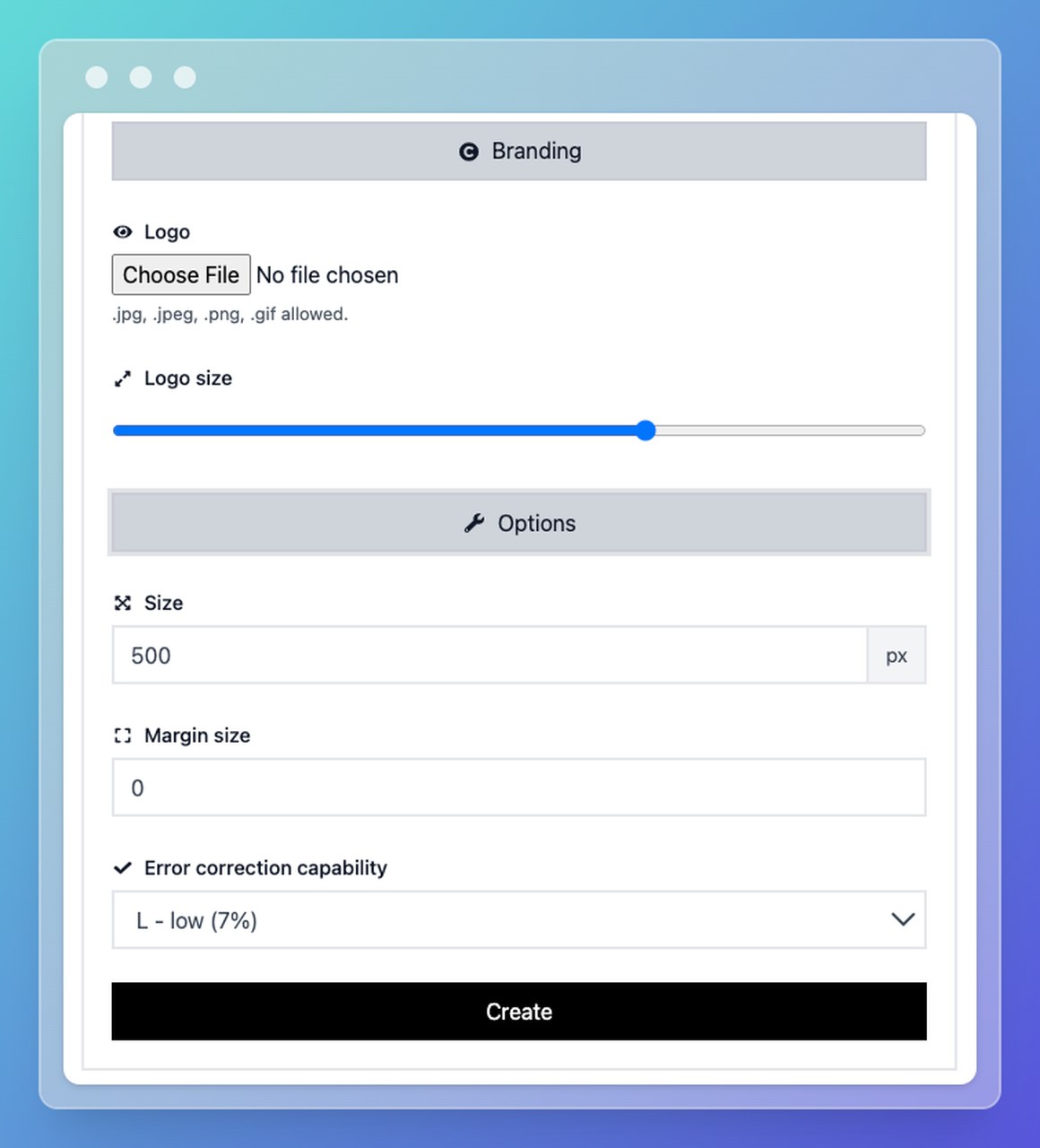
Step 4: Download & Test
- Adjust size and margin in the options panel
- Download in PNG for digital use or SVG/PDF for print
- Scan on both iPhone and Android — confirm all fields save correctly to the address book
- Check that phone numbers include the country code and that the email address is correct
Always place a short CTA like "Scan to Save Contact" near printed QR codes. Without a label, people may assume it's a URL and not bother scanning.
Best Practices for vCard QR Codes
Prioritize Key Fields
Include the essentials: name, phone, email, job title, and company. These are the five fields every saved contact should have. Additional fields (address, birthday, socials) are useful but optional — and each one adds density to the QR pattern, making the code harder to scan at small sizes.
If you're printing the code on a business card (small surface, close scanning distance), keep the fields tight. If it's going on a poster or digital display where size isn't constrained, include everything relevant.
The Density Tradeoff
More fields = more data = denser QR pattern = harder to scan at small sizes. A vCard with name, phone, and email produces a clean, easy-to-scan code. A vCard with 10 fields, a long address, social URLs, and a multi-line note produces a much denser pattern that needs to be printed larger.
If your code looks very dense in the preview, either remove non-essential fields or increase the planned print size. Test at the actual size you'll use before committing to a print run.
Sizing
| Scanning Distance | Minimum QR Size | Typical Placement |
| 15 cm (6 in) | 1.5 cm | Business cards, name badges |
| 30 cm (12 in) | 3 cm | Brochures, résumés, desk signs |
| 1 m (3.3 ft) | 10 cm | Posters, booth signage, lobby displays |
| 3 m (10 ft) | 30 cm | Banners, storefront windows |
Rule: minimum QR size = scanning distance / 10. For digital use, 180 x 180 px minimum. vCard QR codes tend to be denser than simple URL or phone codes, so err on the larger side.
Design Rules
- Contrast: Dark foreground on light background for reliable scanning
- Quiet zone: Leave a clear margin of at least 4 modules around the code
- Logo: Small, centered, and not overlapping the finder patterns
- CTA label: "Scan to Save Contact" or "Add Me to Your Contacts" — tell people what the code does
Keep Information Current
A vCard QR code with an outdated phone number or old email is worse than no code at all — the person saves the contact, trusts it's correct, and reaches out to a dead end. Before every print run, verify that every field in the vCard is current. If you've changed roles, phone numbers, or companies since the last batch, generate a new code.
Use Cases for vCard QR Codes
Business Cards
The most common use case. Print the vCard QR code on the back of your business card so people can scan and save your full contact details instead of manually typing your name, number, and email. The physical card might get lost; the saved contact stays in their phone permanently.
For a modern approach, consider going fully digital with a digital business card — the QR code is the card.
Conferences & Networking Events
Print vCard QR codes on conference badges, lanyards, or table name tents. When you meet someone, they scan your badge instead of exchanging paper cards that end up in a pocket and never get entered. Post-event follow-up is faster because your contact is already saved with the correct spelling, title, and email.
Real Estate
Agents print vCard QR codes on yard signs, brochures, open house flyers, and listing sheets. Prospective buyers scan and save the agent's contact on the spot — no fumbling with a pen to write down a phone number from a sign across the street. A saved contact is more likely to be called than a scribbled number on a receipt.
Freelancers & Creatives
Include portfolio URL, Instagram handle, and email in the vCard so potential clients can explore your work and reach out through their preferred channel. Print the code on postcards, leave-behinds, or even stickers you hand out at meetups.
Job Seekers
Add a vCard QR code to your printed résumé, portfolio, or networking email. Recruiters scan and save your contact instantly instead of manually typing your details from a PDF. Include LinkedIn in the social fields so they can review your profile immediately.
Educators & Speakers
Share contact details at talks, workshops, and classes without printing hundreds of cards. A single QR code on your presentation's final slide or a printed handout lets every attendee save your contact. Include your office hours in the note field so students know when to reach out.
Team Directories & Office Signage
Companies print vCard QR codes on office door signs, reception directories, and internal team pages. Visitors or new employees scan the code for the person they're meeting and have their contact saved before the meeting starts. This is especially useful in large offices or campuses where finding the right person's number can be a multi-step process.
Static vs. Dynamic vCard QR Codes
vCard QR codes are typically static — the contact data is encoded directly into the QR pattern. This means the code works offline but can't be edited after creation.
| Feature | Static QR | Dynamic QR (URL redirect) |
| Edit after printing | No | Yes (via hosted contact page) |
| Works offline | Yes | Needs internet for redirect |
| Saves directly to contacts | Yes (immediate) | Extra step (download from page) |
| Scan analytics | No | Yes (time, device, location) |
| Cost | Free | Paid tiers common |
Static is the right choice for most people. The vCard saves directly to the phone's address book — one scan, one tap, done. No internet needed.
Dynamic makes sense if your contact details change frequently (rotating phone numbers, job changes) or if you need scan analytics. The QR code points to a short URL that redirects to a hosted contact page. The user downloads the .vcf file from that page. The tradeoff: it requires internet and adds an extra step to the save process.
If you want the best of both worlds — offline functionality with the ability to update — print static vCard codes and plan to reprint when details change. For most professionals, contact info doesn't change often enough to justify the friction of a dynamic redirect.
Troubleshooting vCard QR Codes
- Contact saves but fields are missing: Some phones handle vCard fields differently. Social profile links, notes, and birthday fields are well-supported on iOS but may be ignored by some Android contact apps. Test on both platforms and remove fields that don't display correctly if they're critical.
- Phone number has wrong format after saving: Always use international format with country code (e.g., +14155552671). Local formats may not be recognized correctly on devices in different countries.
- Code doesn't scan or takes too long: The vCard likely has too many fields, creating a dense pattern. Remove non-essential fields, increase the print size, or boost contrast. vCard QR codes are among the densest QR types because of the volume of text data.
- Logo causing scan failures: Reduce logo size. vCard codes are already denser than URL or phone codes, so there's less room for error correction to compensate for a logo. Keep the logo under 20% of the code area for dense vCards.
- Saved contact has outdated info: Static vCard codes can't be updated after creation. If your phone number, email, or title has changed, generate and print a new code. There's no way to push an update to already-saved contacts.
Generate Your Free vCard QR Code Now
Create a modern digital contact card in seconds on QRCodeDynamic — no account and no app required. Fill in your details, customize the design, and download.
- No login required for static vCards
- Full field support: name, phone, email, job title, company, website, address, socials, birthday, notes
- Branded customization with colors, logo, and CTA frames
- Exports in PNG, JPG, SVG, or PDF
FAQs About vCard QR Codes
What is the difference between a vCard QR and a URL QR?
A vCard QR stores contact data directly in the QR pattern. When scanned, it opens the phone's "Add Contact" screen with all fields pre-filled. A URL QR redirects to a webpage — which could be an online contact page, but requires internet to load. The vCard version works offline and saves contact info in one step; the URL version is more flexible but adds friction.
Can I include multiple phone numbers or emails?
Yes. The vCard format supports multiple phone numbers (with labels like Work, Mobile, Home) and multiple email addresses. QRCodeDynamic's generator lets you add these fields. Keep in mind that each additional field increases the QR code density, so add only the numbers and emails people will actually use.
Do vCard QR codes work on all phones?
Yes. Modern Android devices (version 5+) and iPhones (iOS 11+) support vCard QR codes natively through the built-in camera app. Older devices may need a third-party QR scanner app, but this is increasingly rare. The .vcf format itself is universally supported across all phone operating systems.
Can I update my contact info after printing?
Not with a static vCard QR code — the data is permanently encoded. To update your info, generate a new code and reprint. If you need post-print flexibility, use a dynamic URL QR code that links to a hosted contact page with a downloadable .vcf file. You can update the page any time, but the user needs internet to access it.
How many fields can I include before the code gets too dense?
There's no hard limit, but in practice, a vCard with more than 8–10 populated fields (especially long URLs and multi-line addresses) creates a dense pattern that's harder to scan at small sizes. For business cards (2–3 cm print size), stick to 5–6 essential fields. For larger placements (posters, screens), you can include the full set.
Can I add a profile photo to the vCard?
The vCard format technically supports embedded photos, but most QR code generators don't include this option because images dramatically increase the data size, making the QR code extremely dense and often unscannable. If you want people to associate a face with the contact, add a link to your LinkedIn or portfolio in the website field — they'll see your photo there.
Is a vCard QR code the same as a digital business card?
Not exactly. A vCard QR code saves raw contact data to the phone's address book. A digital business card is usually a hosted web page with your photo, bio, contact details, and social links — accessed via a URL QR code. The digital card is richer visually but requires internet. The vCard is simpler but saves directly to contacts offline. Choose based on whether you prioritize the instant-save experience (vCard) or a branded visual presentation (digital card).
Can I track how many people scanned my vCard QR code?
Not with a static vCard QR — there's no redirect layer and no analytics. If you need scan tracking, use a dynamic URL QR code pointing to a hosted contact page. You'll see scan data (time, device, location) in your dashboard, though you won't know if the visitor actually saved the contact from the page.