QR Code Reader -Scan QR Codes Free
Scan all the QR codes existing from the image files.
Free QR Code Reader: Scan & Decode QR Codes Online
You've got a QR code image — a screenshot, a photo from a flyer, or a code embedded in a document — and you need to know what's inside it. QRCodeDynamic's QR Code Reader decodes it in seconds, directly in your browser. No app to download, no account to create.
You can use this tool constantly when testing QR codes before printing, verifying codes clients send me, or checking what a competitor's QR code actually links to. Upload an image or point your camera at a code, and the embedded data appears instantly.
Let's cover how the QR code reader works, how to use it on desktop and mobile, what types of codes it can decode, and when you'd use an online reader instead of your phone's built-in camera.
What Is a QR Code Reader?
A QR code reader is a tool that decodes the information stored inside a QR code — whether that's a URL, plain text, contact details, WiFi credentials, event data, or a payment link.
QRCodeDynamic's reader works entirely in the browser. It uses image processing algorithms to analyze the black-and-white pattern of a QR code and extract the embedded data. You can either upload an image file containing a QR code or scan a code in real time using your device's camera.
It handles both static and dynamic QR codes — the reader decodes whatever data is in the pattern, whether that's a direct URL, a redirect link, a vCard, or a WiFi configuration string.
How Does The QR Code Reader Work
- Upload or scan: Upload an image (PNG, JPG, JPEG, SVG, or WEBP, up to 8 MB) or use your camera to scan a code in real time.
- Decoding: The reader analyzes the QR pattern and extracts the embedded information.
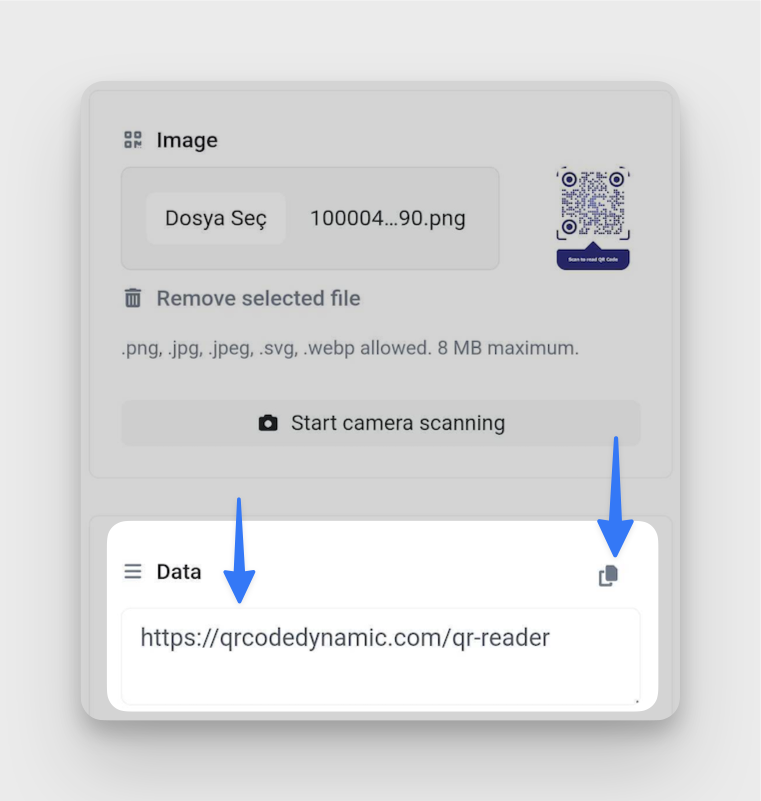
- Results: The decoded data — URL, text, contact info, event details, or whatever the code contains — appears instantly. Copy it to your clipboard with one click.
Why Use an Online QR Reader Instead of Your Phone Camera?
Most modern phones can scan QR codes with the built-in camera. So why use a browser-based reader? Several reasons:
- You have a screenshot or image file, not a physical code. Your phone camera can't scan a QR code that's already on your screen. An online reader can decode QR code images from files, screenshots, documents, and emails.
- You're on a desktop or laptop. Most desktops don't have a convenient QR scanning setup. Upload the image instead.
- You want to see the raw data before opening it. Your phone camera typically auto-opens URLs. An online reader shows you the decoded content first — so you can verify a link is safe before clicking it.
- You're testing QR codes you created. Before printing a batch, upload the generated image to verify the encoded data is correct without pulling out your phone.
- The code is damaged or low-quality. Online readers with advanced processing can sometimes decode blurry, partially damaged, or low-contrast codes that a phone camera struggles with.
How to Use the QR Code Reader
How to Scan QR Codes On Desktop
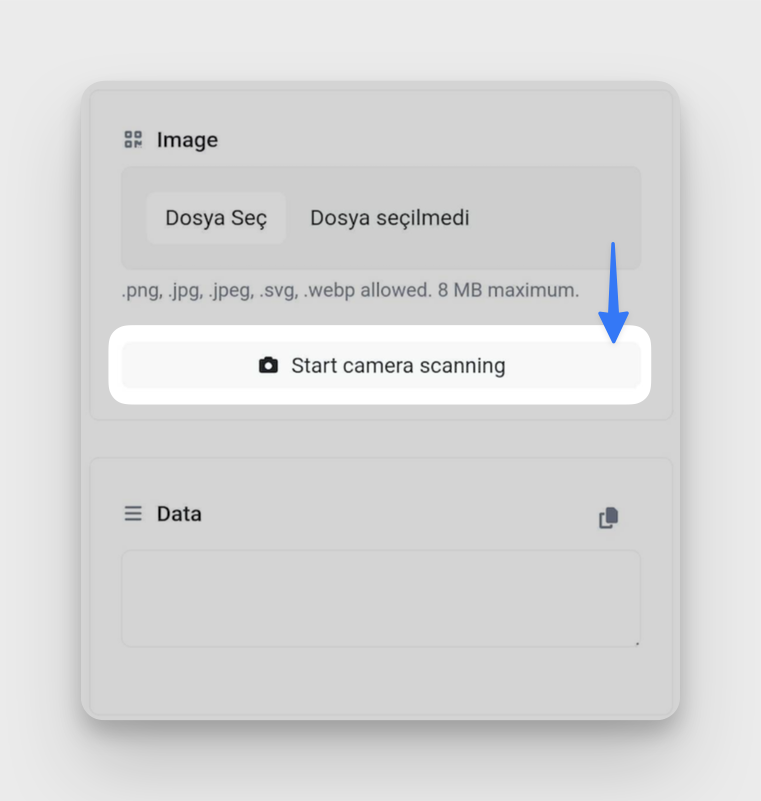
Option 1: Upload an image. Click "Choose File" and select an image containing the QR code from your computer. Supported formats: PNG, JPG, JPEG, SVG, and WEBP (max 8 MB).
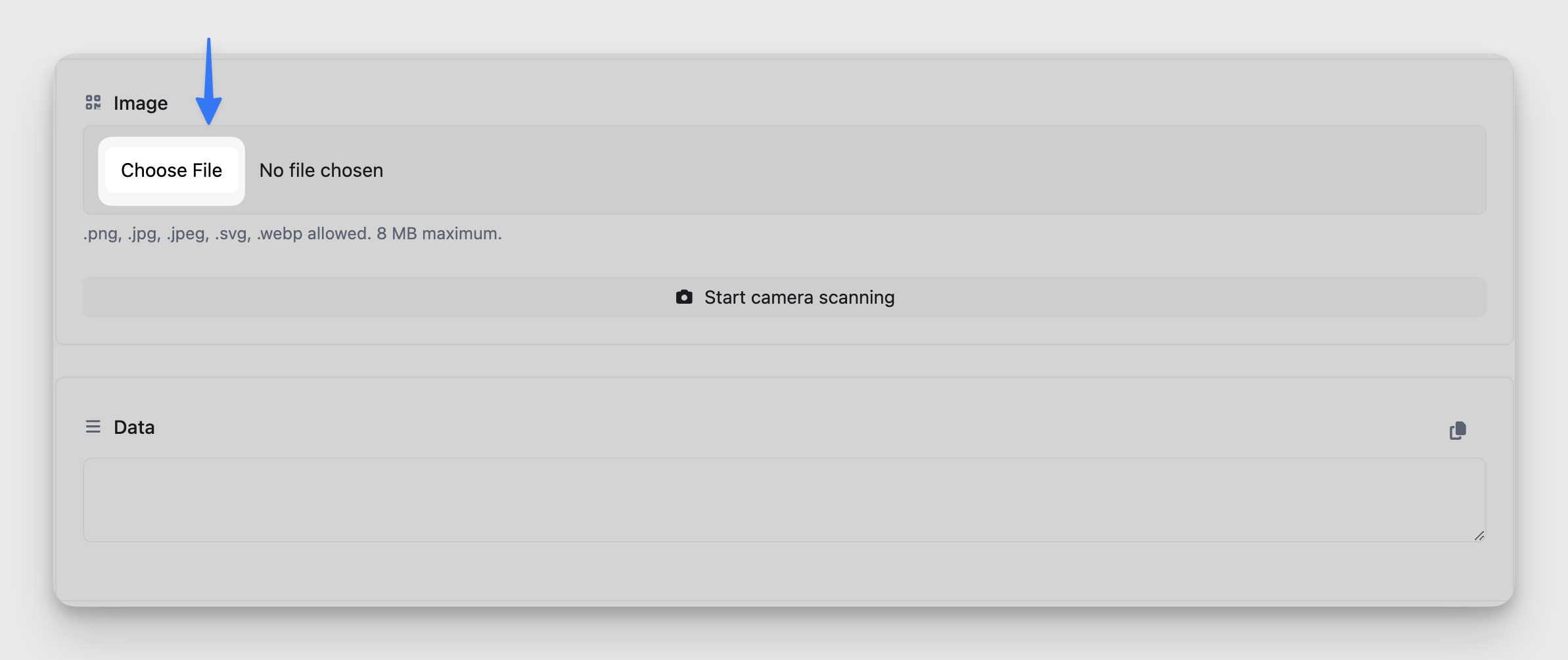
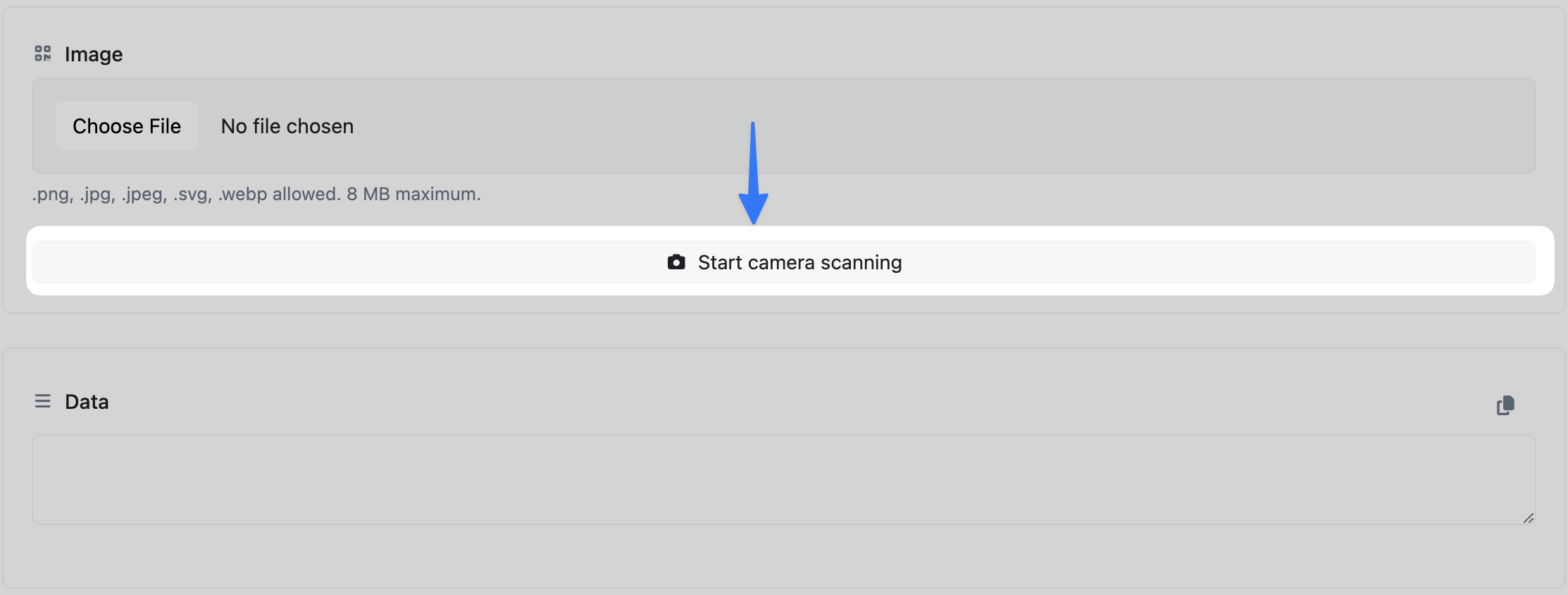
Option 2: Use your camera. Click "Start camera scanning" to scan a physical QR code using your webcam or built-in camera. Point the camera at the code and the reader will detect and decode it automatically.
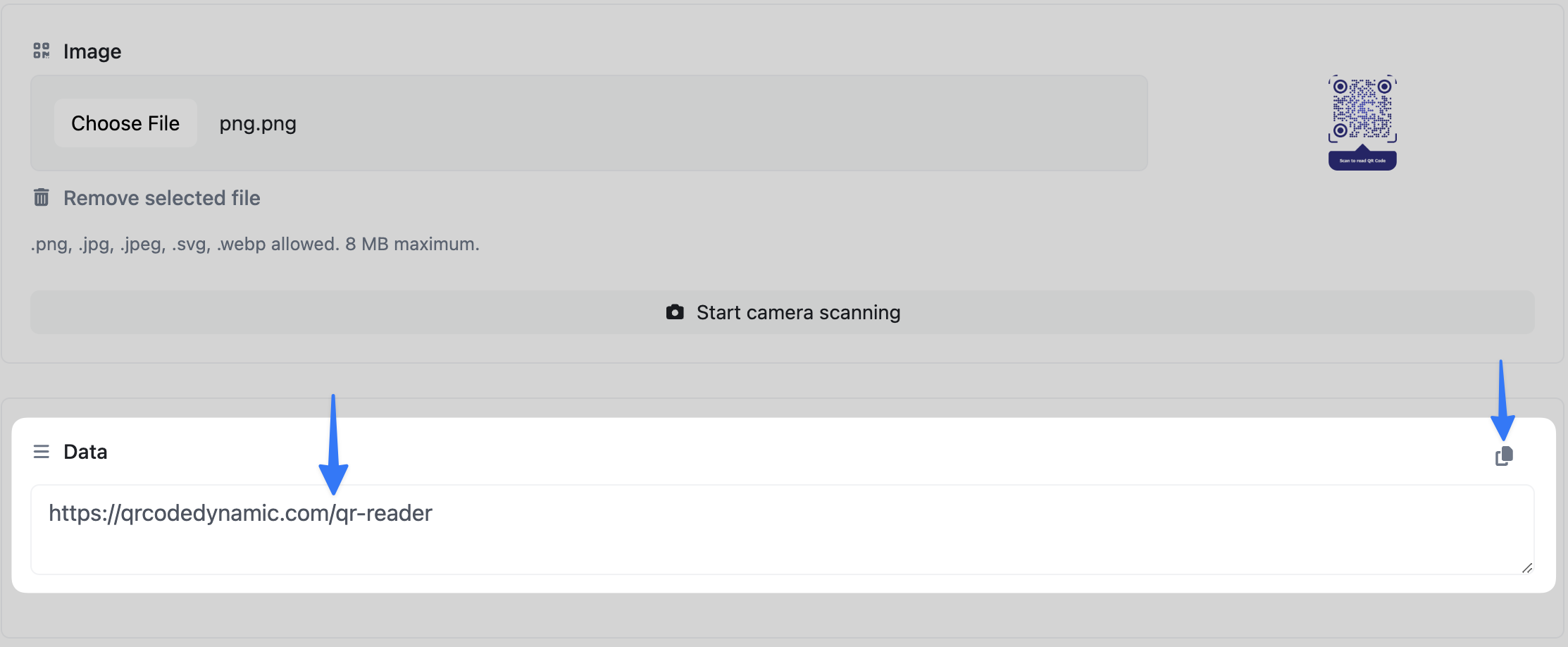
Read the result. The decoded content appears in the "Data" section. Click the copy icon to copy the data to your clipboard.
How to Scan QR Codes On Mobile
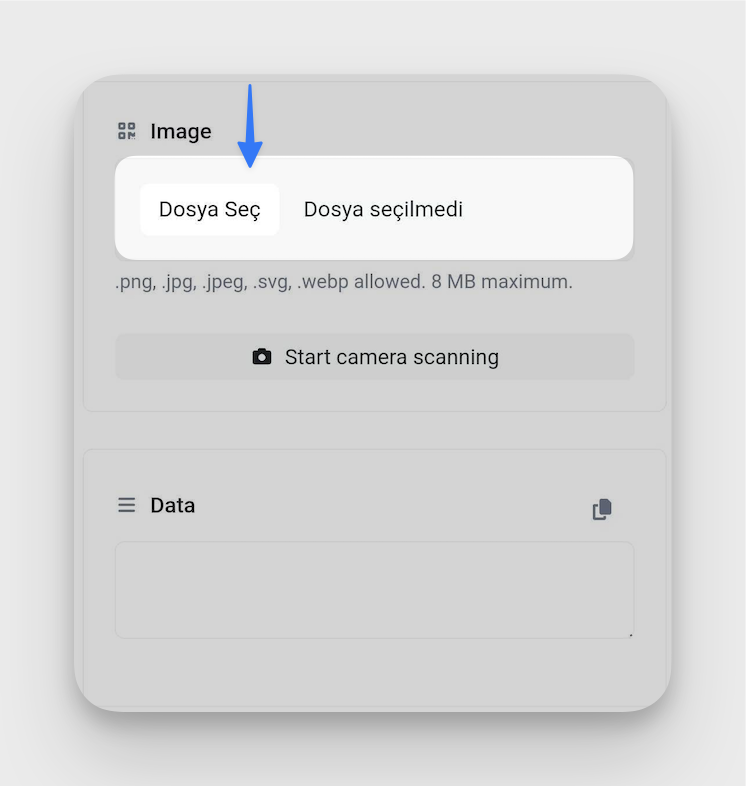
Option 1: Upload an image. Tap "Choose File" and select a QR code image from your photo library. Same format support as desktop: PNG, JPG, JPEG, SVG, WEBP (max 8 MB).
Option 2: Use your camera. Tap "Start camera scanning" and point your phone at the QR code. The reader decodes it in real time.
Read the result. The decoded data appears in the "Data" section. Tap the copy icon to copy it.
What Types of QR Codes Can It Read?
The reader decodes any standard QR code regardless of what data type is encoded. Here's what you might find inside:
| Data Type | What the Reader Shows | Example |
| URL | The full web address | https://example.com/product |
| Text | The text message | "Use code SAVE20 at checkout" |
| vCard | Contact details (name, phone, email) | BEGIN:VCARD... (full contact data) |
| WiFi | Network name, password, encryption type | WIFI:T:WPA;S:CafeGuest;P:pass123;; |
| Email (mailto) | Recipient, subject, body | mailto:[email protected]?subject=... |
| Phone (tel) | Phone number | tel:+14155552671 |
| SMS | Phone number + prefilled message | sms:+15551234567?body=Hello |
| Event (.ics) | Event name, date, time, location | Calendar event data |
| Crypto | Wallet address + optional amount | bitcoin:bc1q...?amount=0.01 |
| Location (geo) | Latitude and longitude | geo:40.7128,-74.0060 |
The reader displays the raw decoded data, so you can see exactly what's encoded before taking action. This is especially useful for security — you can verify a URL is legitimate before visiting it.
Use Cases for a QR Code Reader
Testing QR Codes Before Printing
This is my most frequent use case. After generating a QR code, I upload the image file to the reader to verify the encoded data is correct — the right URL, the right phone number, the right vCard fields. Catching an error here saves a reprint of 5,000 flyers.
Verifying Unknown QR Codes
Before scanning a QR code from an unfamiliar source with your phone (which may auto-open the link), upload an image of it to the reader first. You'll see the raw URL or data without your browser opening a potentially malicious page. This is basic QR code security hygiene.
Decoding Screenshots and Digital Images
Someone sends you a QR code in a PDF, an email, a Slack message, or a presentation. Your phone camera can't scan an image on the same screen you're looking at. Upload the file to the reader and get the data instantly.
Shopping & Retail
Scan product packaging to access reviews, track shipments, or redeem promotions. If you want to create your own product QR codes, check out our guide on 13 Ways to Use QR Codes on Product Packaging.
Events & Tickets
Decode QR-coded tickets, access event schedules, or verify ticket authenticity. Learn more about using dynamic QR codes for events.
Travel & Hospitality
Scan boarding passes, hotel check-in codes, restaurant menus, and attraction tickets. Travelers can also use QR codes for luggage tagging to streamline check-in and reduce lost baggage.
Education
Access learning resources, submit assignments, or participate in quizzes linked to QR codes. Discover more in 21 Creative Ways to Use QR Codes in the Classroom.
Professional & Workplace
Decode QR codes on business cards to extract contact details, scan meeting invite codes, or access troubleshooting guides linked to equipment labels.
QR Code Reader vs. Phone Camera: When to Use Each
| Scenario | Use Phone Camera | Use Online QR Reader |
| Physical code in front of you | Yes — fastest option | Not needed |
| QR code in a screenshot or document | Can't scan your own screen | Yes — upload the file |
| Working on a desktop without camera | Not possible | Yes — upload the image |
| Want to verify link before opening | Auto-opens URL (risky) | Yes — shows raw data first |
| Testing a QR code you just created | Works but slower | Yes — upload the generated file directly |
| Damaged or low-contrast code | May fail | Better processing for edge cases |
Both tools have their place. The phone camera is faster for physical codes. The online reader is better for digital images, desktop workflows, security verification, and QR code testing.
QR Code Reader and Supported File Formats
- PNG — most common format for generated QR codes
- JPG / JPEG — photos of printed QR codes, screenshots
- SVG — vector files from QR generators (decoded from the embedded image data)
- WEBP — modern web format, increasingly common in screenshots and web exports
Maximum file size: 8 MB. If your image is larger, resize or compress it before uploading. The QR code itself should be clearly visible in the image — the reader needs the full pattern including the three finder squares (corners) to decode successfully.
Tips for Successful QR Code Scanning
- Image quality matters. A blurry photo of a QR code will be harder to decode than a clean screenshot. If you're photographing a printed code, hold your camera steady and make sure the entire code (including quiet zone margins) is in frame.
- Ensure full visibility. The reader needs to see the complete QR code pattern, including all three finder squares. A partially cropped image will fail.
- Avoid glare and shadows. If photographing a printed code, avoid flash reflections and harsh shadows across the pattern.
- One code per image. If the image contains multiple QR codes, the reader may decode only one or get confused. Crop to isolate the specific code you want to read.
- Check the orientation. QR codes can be decoded at any rotation, but severely distorted images (extreme angles, warped perspectives) may fail. Straighten the image if possible.
Create Your Own QR Codes with QRCodeDynamic
Reading QR codes is half the equation. If you need to create your own, QRCodeDynamic's QR code generator supports over a dozen types:
- URL QR codes — link to any webpage
- Text QR codes — display plain text messages
- vCard QR codes — save contact details
- Phone QR codes — trigger a call
- WiFi QR codes — connect to a network
- Event QR codes — add to calendar
- And more: Email, SMS, WhatsApp, Location, Crypto, FaceTime, PayPal
Customize colors, add your logo, choose a CTA frame, and download in PNG, SVG, or PDF. Learn more about creative QR code design to make your codes match your brand.
FAQs About the QR Code Reader
Is QRCodeDynamic's QR Code Reader free?
Yes. The QR code reader is completely free to use with no hidden fees, subscriptions, or limits on the number of scans. Open it in your browser and start decoding.
Do I need to download an app to use the QR Code Reader?
No. The reader works entirely in your browser — desktop or mobile. No app installation, no account creation. Just visit the page, upload an image or start camera scanning, and get your result.
What types of QR codes can it read?
Any standard QR code. The reader decodes URLs, plain text, vCard contacts, WiFi credentials, email (mailto) links, phone numbers (tel), SMS messages, calendar events (.ics), crypto wallet addresses, location coordinates, and more. If the data is encoded in a valid QR pattern, the reader will extract it.
Can I use it on my phone?
Yes. The tool is fully optimized for mobile browsers. You can upload an image from your photo library or use your phone's camera to scan a code in real time. It works on both iOS (Safari, Chrome) and Android (Chrome, Firefox, Samsung Internet).
Is it safe to scan unknown QR codes with this reader?
Safer than scanning with your phone camera. Your phone camera typically auto-opens URLs, which can expose you to phishing sites or malicious redirects. The online reader shows you the raw decoded data (the URL or text) without opening it. You can inspect the link before deciding whether to visit it. This makes it a good tool for verifying QR codes from unknown or untrusted sources.
Can the reader decode damaged or blurry QR codes?
It depends on the extent of the damage. QR codes have built-in error correction (7%–30% of the pattern can be damaged and still decode, depending on the error correction level). If the code is lightly scratched, partially faded, or slightly blurry, the reader will likely decode it. If critical areas (finder patterns, alignment markers) are missing or heavily obscured, decoding will fail.
Does it work with dynamic QR codes?
Yes. The reader decodes whatever is encoded in the QR pattern. For dynamic codes, that's typically a short redirect URL. The reader shows you that redirect URL. To see the final destination, you'd need to follow the redirect — the reader itself only shows the first-level encoded data.
What's the maximum file size for uploads?
8 MB. Supported formats are PNG, JPG, JPEG, SVG, and WEBP. If your file is larger, resize or compress it before uploading. The QR code should be clearly visible in the image with all three finder squares (corner markers) intact.
Can I scan multiple QR codes from one image?
The reader is designed to decode one QR code per image. If your image contains multiple codes, crop it to isolate the specific one you want to decode. Uploading an image with several QR codes may result in only one being read, or the reader may not pick up any of them.