QR Code for Logistics: Improve Tracking and Inventory Management


On this page
- What Is a QR Code for Logistics?
- How QR Codes Work in Logistics Operations
- QR Codes vs Traditional Barcodes
- Why Logistics Companies Are Paying Attention
- Why QR Codes Are Important in Modern Logistics
- Faster Package Identification 📦
- Improved Inventory Accuracy
- Better Supply Chain Visibility
- Supporting Automation and Digital Transformation
- Key Advantages at a Glance
- Common Use Cases of QR Codes in Logistics
- Shipment Tracking
- Warehouse Inventory Management
- Asset Tracking
- Delivery Verification
- Returns and Reverse Logistics
- Supply Chain Traceability
- Quick Overview of Logistics QR Code Applications
- Benefits of Using QR Codes in Logistics Operations
- Reduced Manual Errors
- Real-Time Data Access
- Lower Operational Costs
- Faster Workflow Automation ⚡
- Why Dynamic QR Codes Are Particularly Useful
- Managing Logistics QR Codes at Scale
- The Biggest Benefits at a Glance
- Static vs Dynamic QR Codes for Logistics
- What Is a Static QR Code?
- What Is a Dynamic QR Code?
- Side-by-Side Comparison
- Which Option Is Better for Logistics?
- When Should You Choose Dynamic QR Codes?
- Best Practices for Implementing QR Codes in Logistics
- Standardize Your QR Code System
- Place QR Codes Where They're Easy to Scan
- Keep Linked Information Updated
- Train Employees Early
- Start Small, Then Scale
- Focus on Long-Term Visibility
- Conclusion
- Frequently Asked Questions
A QR code for logistics is a scannable code used to track shipments, manage inventory, monitor assets, and improve supply chain visibility. Unlike traditional barcodes, logistics QR codes can store more information and connect workers to real-time tracking systems, inventory databases, delivery records, and operational workflows with a single scan.
Whether you're managing a warehouse, handling inventory tracking, or optimizing shipment operations, QR codes in logistics help reduce manual errors, improve efficiency, and streamline logistics management.
What Is a QR Code for Logistics?
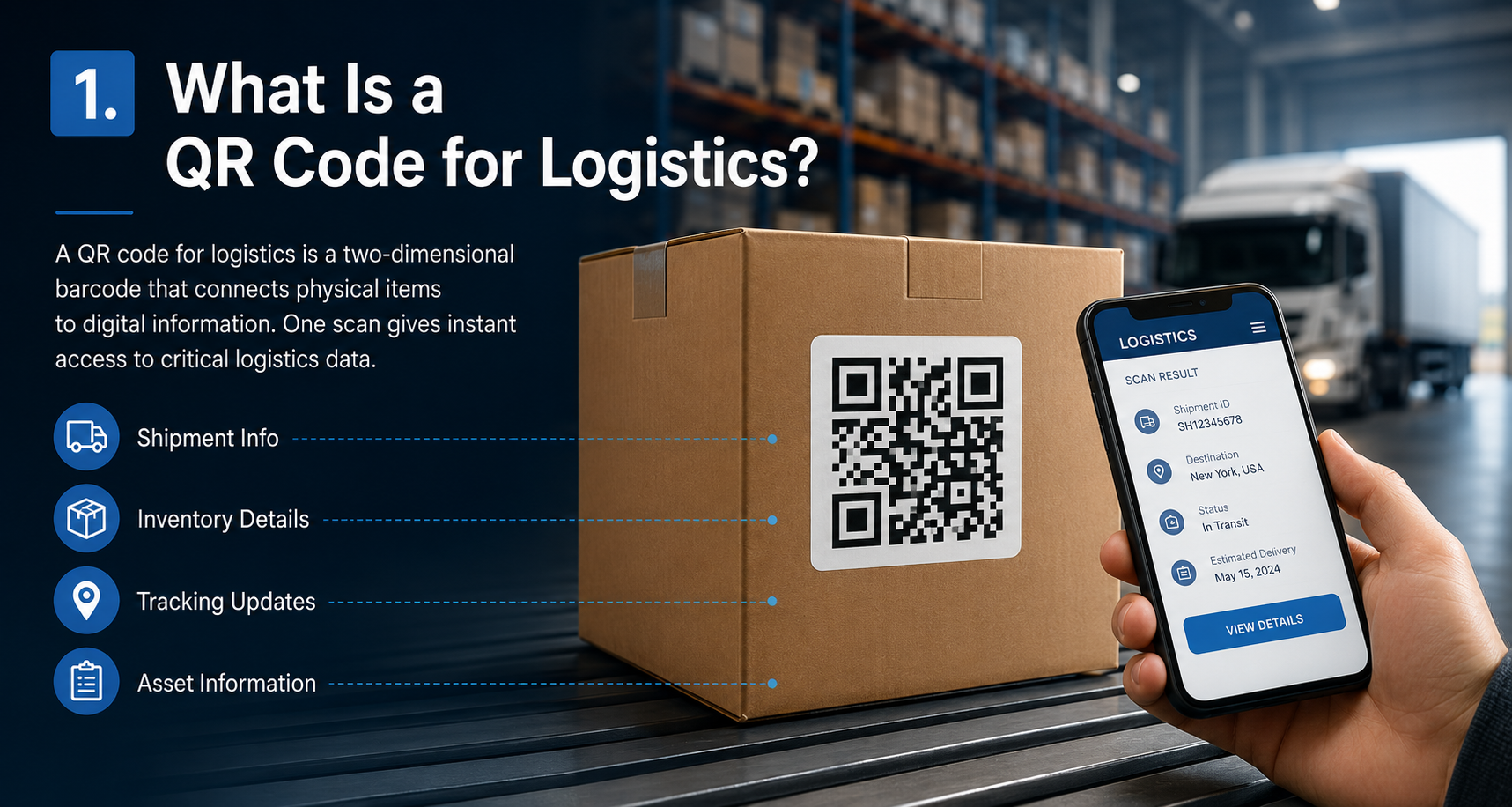
A QR code for logistics is a two-dimensional barcode that allows businesses to instantly access information about shipments, inventory, assets, deliveries, or warehouse operations through a simple scan.
At first glance, a logistics QR code might look like a standard barcode.
In practice, it can do much more.
Traditional barcodes usually contain a limited amount of information and often act as a simple identifier. QR codes, on the other hand, can connect directly to cloud-based systems, inventory databases, shipment records, digital forms, proof-of-delivery documents, and real-time tracking platforms.
That extra flexibility is one reason many organizations are incorporating QR codes in logistics and supply chain operations.
For example, a single QR code attached to a package could provide access to:
- Shipment status
- Tracking history
- Delivery instructions
- Product information
- Warehouse location
- Customer records
- Proof of delivery
Instead of manually searching through multiple systems, workers can retrieve everything they need with one scan. 📱
How QR Codes Work in Logistics Operations
The process is surprisingly simple.
- A QR code is generated and assigned to an item, package, pallet, container, or asset.
- The code is printed or displayed digitally.
- Workers scan the code using a smartphone, tablet, or handheld scanner.
- The scan retrieves or updates information within the logistics management system.
Because the information can be updated continuously, QR codes become a bridge between physical goods and digital records.
This is especially valuable for businesses handling large inventories or complex distribution networks where visibility is critical.
QR Codes vs Traditional Barcodes
Many logistics teams ask whether QR codes are actually better than barcodes.
In my experience, the answer depends on the amount of information you need to manage.
Here's a quick comparison:
Feature | Traditional Barcode | QR Code |
Data Capacity | Limited | High |
Scan Direction | Usually one angle | Multiple angles |
Error Correction | Limited | Advanced |
Links to Online Systems | No | Yes |
Inventory Tracking | Basic | Advanced |
Asset Tracking | Limited | Strong |
Real-Time Updates | No | Yes (with dynamic QR codes) |
For simple product identification, barcodes still work well.
For QR code inventory management, QR code asset tracking, and QR code shipment tracking, QR codes typically provide far more flexibility.
Why Logistics Companies Are Paying Attention
Supply chains are becoming more data-driven every year.
According to the global standards organization GS1, industries worldwide are moving toward next-generation product identification systems that support richer data and improved traceability.
That trend makes sense.
Customers expect faster deliveries.
Managers want better visibility.
Warehouse teams need faster workflows.
And businesses want fewer costly mistakes.
A well-designed QR code logistics management system helps support all four goals simultaneously.
That is why QR codes are no longer limited to retail packaging. They are increasingly becoming part of modern warehouse management, shipment tracking, inventory control, and broader supply chain operations.
Why QR Codes Are Important in Modern Logistics
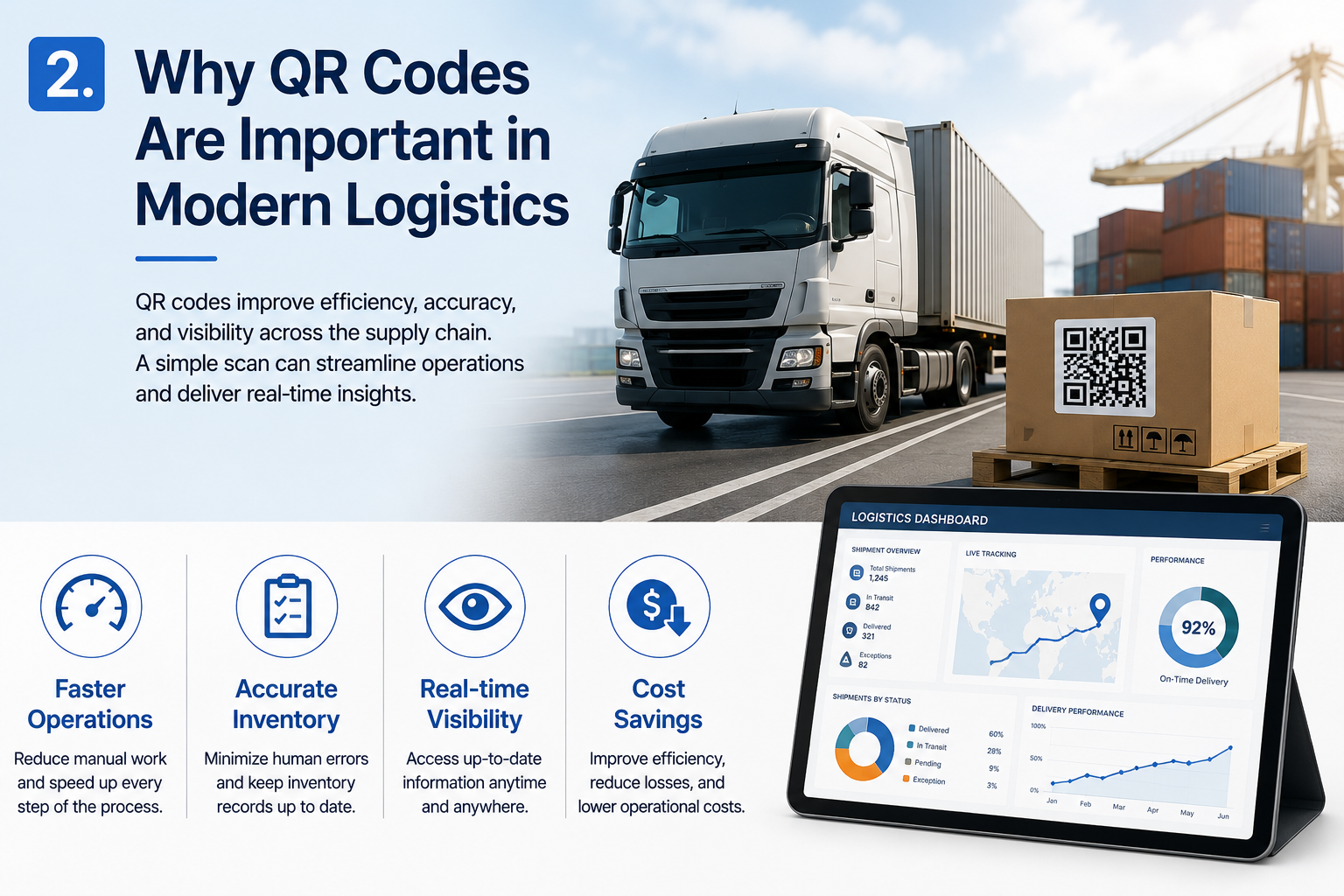
Logistics has always been a race against time.
The faster information moves, the faster products move.
Unfortunately, many logistics operations still rely on manual data entry, disconnected systems, paper records, or outdated tracking methods that slow everything down.
This is where a QR code for logistics can create an immediate impact.
Instead of searching spreadsheets, entering tracking numbers manually, or calling different departments for updates, employees can access critical information in seconds through a simple scan.
I think this is one of the biggest reasons QR codes have become so valuable in modern supply chains. They don't just store information. They make information accessible exactly when it's needed.
Faster Package Identification 📦
Every second matters in a busy warehouse.
When workers need to identify products, pallets, containers, or shipments quickly, delays can multiply across the entire operation.
A shipping QR code or QR code package tracking system allows employees to instantly access shipment details without manually searching databases.
For example, a warehouse worker scanning a package can immediately view:
- Destination information
- Shipment status
- Product details
- Handling instructions
- Delivery deadlines
This reduces bottlenecks and helps teams process larger volumes more efficiently.
In environments handling thousands of daily shipments, even small time savings can have a significant operational impact.
Improved Inventory Accuracy
Inventory mistakes are expensive.
A misplaced item, incorrect stock count, or inventory discrepancy can create delays throughout the supply chain.
According to research from the National Retail Federation (NRF), inventory inaccuracies continue to be a major operational challenge for businesses managing large product volumes.
A QR code inventory management system helps reduce these errors by making inventory updates faster and more reliable.
Instead of manually recording movements, employees can scan products whenever they:
- Enter the warehouse
- Change storage locations
- Move between facilities
- Leave for shipment
- Return through reverse logistics
As a result, inventory records stay more accurate and easier to maintain.
Better Supply Chain Visibility
One of the most common complaints I hear from logistics teams is simple:
"We don't know where something is until somebody asks."
Visibility gaps create problems for everyone involved.
Managers struggle to make decisions.
Customer support teams spend time searching for updates.
Customers become frustrated when shipment information is unavailable.
This is where supply chain QR codes become extremely useful.
Each scan creates a digital touchpoint that can update tracking systems in real time.
Over time, these touchpoints build a complete movement history for products, assets, or shipments across the supply chain.
The result is greater transparency and fewer surprises.
Supporting Automation and Digital Transformation
Modern logistics is increasingly driven by automation.
According to the industry association MHI, technologies such as automation, real-time visibility tools, and digital tracking systems continue to be major investment priorities across supply chain organizations.
QR codes fit naturally into this transition.
They can connect with:
- Warehouse management systems (WMS)
- Enterprise resource planning (ERP) platforms
- Inventory management software
- Delivery management tools
- Asset tracking systems
Because QR codes are inexpensive to implement and easy to scale, they often become one of the simplest entry points into broader logistics digitization initiatives.
Key Advantages at a Glance
Benefit | Operational Impact |
Faster scanning | Reduced processing time |
Better inventory tracking | Improved stock accuracy |
Real-time updates | Increased visibility |
Asset tracking | Reduced losses |
Workflow automation | Higher productivity |
Digital records | Better compliance and reporting |
The bottom line is simple:
A well-implemented logistics QR code system helps businesses move information as efficiently as they move products. And in modern logistics, those two things are becoming inseparable.
Common Use Cases of QR Codes in Logistics
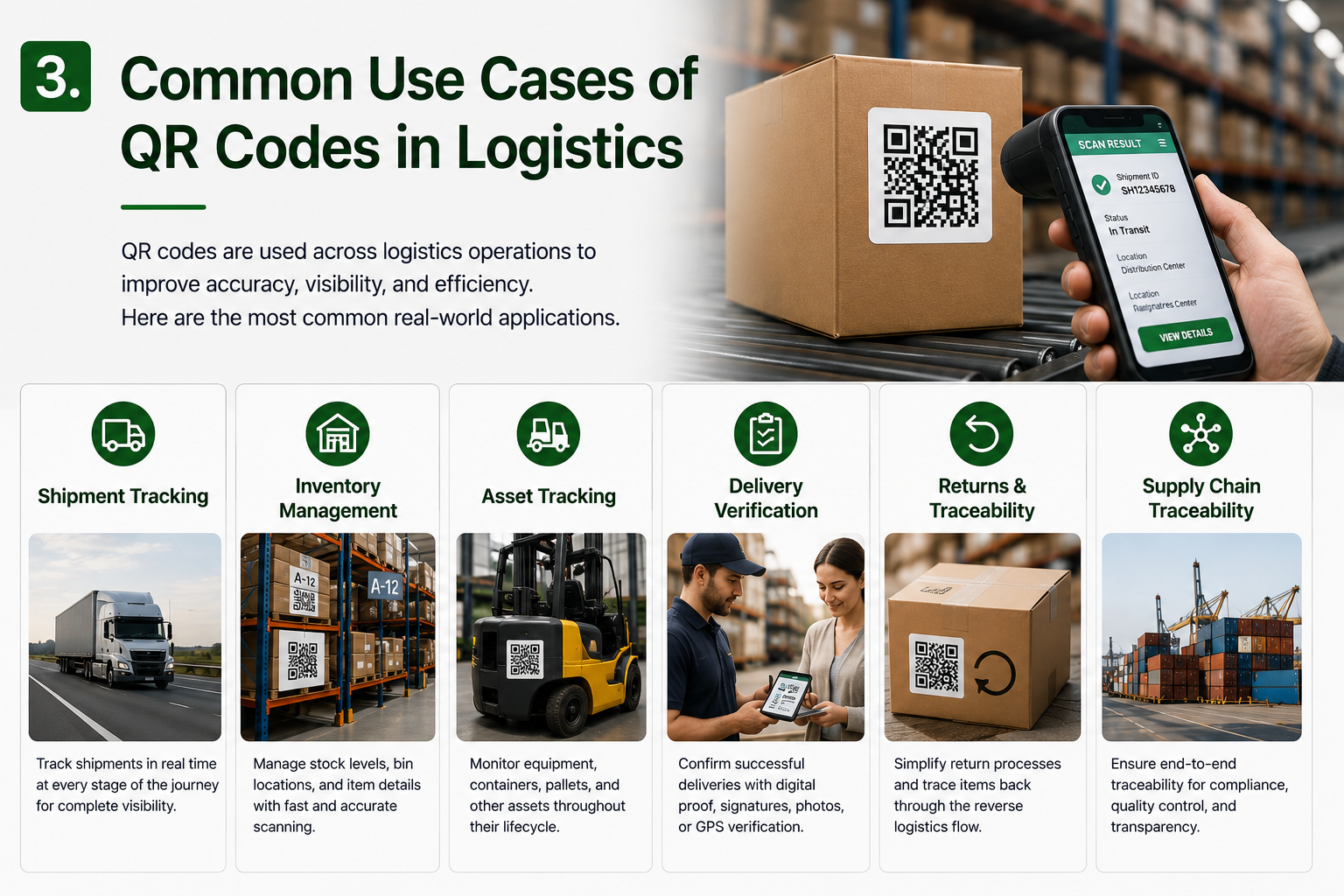
One reason I like writing about QR codes in logistics is that they are surprisingly versatile.
Many people initially think of them as simple tracking tools.
In reality, a single QR code for logistics can support multiple workflows across warehousing, transportation, inventory management, asset monitoring, and delivery operations.
Let's look at some of the most practical applications.
Shipment Tracking
Shipment tracking is probably the most common use case.
Every package moves through multiple stages before reaching its destination:
- Warehouse processing
- Sorting centers
- Transportation hubs
- Delivery vehicles
- Final delivery
A QR code shipment tracking system creates visibility throughout that journey.
Each time a shipment is scanned, the system can record:
Tracking Data | Why It Matters |
Location | Know where the shipment is |
Timestamp | Verify movement history |
Handler Information | Improve accountability |
Delivery Status | Keep customers informed |
Exceptions or Delays | Enable faster problem resolution |
Instead of relying on manual updates, logistics teams receive a clearer picture of where shipments are and how they are progressing through the network.
Warehouse Inventory Management
Warehouses often contain thousands—or even millions—of items.
Without an efficient tracking system, inventory quickly becomes difficult to manage.
This is where a warehouse QR code system becomes extremely useful.
Workers can scan QR codes to:
- Receive incoming inventory
- Move products between storage locations
- Conduct stock counts
- Pick items for orders
- Process returns
The result is a faster and more accurate inventory tracking QR code workflow.
In my experience, inventory management is one of the areas where QR codes generate value almost immediately because they eliminate a significant amount of manual data entry.
Asset Tracking
Logistics operations rely on more than products.
They also depend on physical assets such as:
- Forklifts
- Containers
- Trailers
- Pallets
- Warehouse equipment
- Scanners and devices
Losing track of these assets creates unnecessary costs.
A QR code asset tracking system gives each asset a unique digital identity.
With a quick scan, teams can view:
- Asset location
- Maintenance history
- Assigned personnel
- Inspection records
- Usage status
This makes it easier to manage equipment throughout its lifecycle while reducing losses and improving accountability.
Delivery Verification
Deliveries don't always end when a package arrives.
Businesses often need proof that the delivery was completed correctly.
A shipping QR code can simplify this process.
Drivers can scan a code at the point of delivery and instantly update the logistics system.
Depending on the workflow, the scan can be combined with:
- Customer signatures
- Photos
- GPS verification
- Delivery notes
- Digital forms
This creates a clear record of the completed delivery and helps reduce disputes later.
Returns and Reverse Logistics
Returns are often overlooked when discussing logistics technology.
Yet reverse logistics can be just as complex as outbound shipping.
QR codes help simplify the process by allowing customers or warehouse staff to access return instructions, shipping labels, product details, and tracking information through a single scan.
For businesses handling large return volumes, this can significantly improve efficiency while reducing customer frustration.
Supply Chain Traceability
Today's customers and regulators increasingly expect transparency.
Many organizations need to know exactly where products originated, how they moved through the supply chain, and when specific events occurred.
This is why QR code supply chain management has become increasingly important.
For example, QR codes can be used to document:
- Manufacturing dates
- Distribution records
- Quality inspections
- Warehouse transfers
- Delivery milestones
Organizations in industries such as food, pharmaceuticals, manufacturing, and retail often use QR codes to improve traceability and maintain better records.
Quick Overview of Logistics QR Code Applications
Use Case | Primary Benefit |
Shipment Tracking | Real-time visibility |
Inventory Management | Improved stock accuracy |
Asset Tracking | Better equipment control |
Delivery Verification | Reduced disputes |
Returns Processing | Faster reverse logistics |
Supply Chain Traceability | Stronger compliance and transparency |
What I find most interesting is that many businesses start with a single use case—usually shipment tracking or inventory management—and then gradually expand QR code adoption across their entire logistics operation.
Once teams see how much time a simple scan can save, finding additional use cases becomes surprisingly easy.
Benefits of Using QR Codes in Logistics Operations
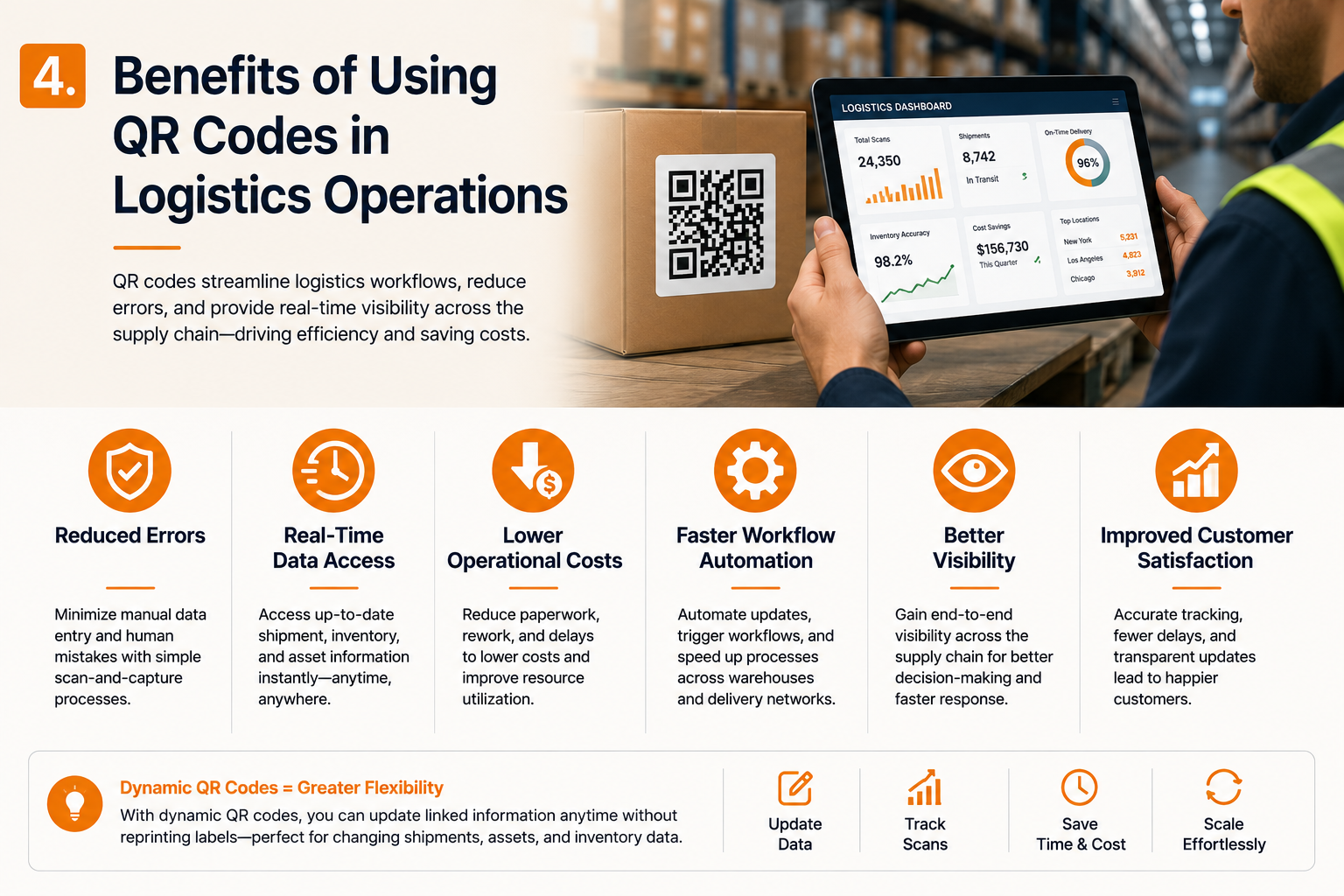
The use cases are important.
But what most decision-makers really want to know is this:
What business value does a QR code for logistics actually deliver?
After working in the QR code space for several years, I've noticed that successful logistics implementations almost always focus on four outcomes: fewer errors, better visibility, lower costs, and faster operations.
Let's break those down.
Reduced Manual Errors
Manual processes create opportunities for mistakes.
A mistyped tracking number.
An incorrect inventory entry.
A misplaced shipment update.
Even small errors can create delays that ripple across the supply chain.
A logistics QR code system minimizes these risks because information is captured through scanning rather than manual entry.
Instead of typing data repeatedly, employees simply scan and update records automatically.
This creates a more reliable workflow while reducing the time spent correcting mistakes later.
Real-Time Data Access
One of the biggest advantages of QR code logistics management is instant access to information.
When a worker scans a QR code, they can immediately retrieve the latest data connected to that shipment, product, asset, or delivery.
This is especially valuable when teams need quick answers.
For example:
- Is the shipment delayed?
- Which warehouse is holding the item?
- Has the asset been inspected recently?
- Has the customer received the package?
Instead of waiting for updates from multiple departments, employees can often find the information themselves within seconds.
Lower Operational Costs
I don't think QR codes are a magic solution that eliminates operational costs overnight.
However, they can significantly reduce inefficiencies.
When logistics teams spend less time on:
- Manual data entry
- Inventory reconciliation
- Asset searches
- Delivery disputes
- Administrative tasks
they can allocate resources more effectively elsewhere.
Because QR codes are inexpensive to generate and deploy, the barrier to entry is relatively low compared to many other logistics technologies.
Faster Workflow Automation ⚡
Speed matters in logistics.
The faster information moves, the faster operations move.
QR codes help automate routine tasks by connecting physical items directly to digital systems.
A single scan can:
- Update inventory levels
- Confirm delivery completion
- Record warehouse movements
- Open digital forms
- Trigger workflow actions
This reduces administrative overhead and allows employees to focus on higher-value activities.
Why Dynamic QR Codes Are Particularly Useful
If you're implementing QR codes across a logistics network, I strongly recommend considering dynamic QR codes for logistics.
Static QR codes work well for fixed information.
Dynamic QR codes offer much greater flexibility.
For example, you can update the destination URL or linked information without reprinting the code itself.
That may not sound like a huge advantage initially.
But imagine managing thousands of shipments, assets, or warehouse labels.
Being able to update information centrally rather than replacing every QR code can save considerable time and operational effort.
This is one reason many logistics teams prefer dynamic QR codes for long-term deployments.
Managing Logistics QR Codes at Scale
As QR code usage grows, management becomes just as important as creation.
A logistics operation may eventually need hundreds or thousands of QR codes assigned to shipments, inventory locations, equipment, or delivery workflows.
This is where a platform like QRCode Dynamic becomes particularly useful.
Rather than generating individual codes one at a time, businesses can create, organize, update, and monitor QR codes from a centralized dashboard.
Features such as dynamic QR codes, scan analytics, and easy code management make it easier to support growing logistics operations without adding unnecessary complexity.
When you're dealing with warehouse workflows, inventory tracking, and supply chain visibility, having that flexibility can make a meaningful difference.
The Biggest Benefits at a Glance
Benefit | Logistics Impact |
Reduced Errors | More accurate records and tracking |
Real-Time Access | Faster decision-making |
Lower Costs | Less administrative overhead |
Workflow Automation | Increased operational efficiency |
Dynamic Updates | Easier large-scale management |
Better Visibility | Improved supply chain control |
Ultimately, the value of a QR code for warehouse management, shipment tracking, or inventory control isn't just about scanning faster.
It's about creating a logistics operation where information flows as efficiently as products do.
And in today's supply chains, that advantage can be surprisingly powerful.
Static vs Dynamic QR Codes for Logistics
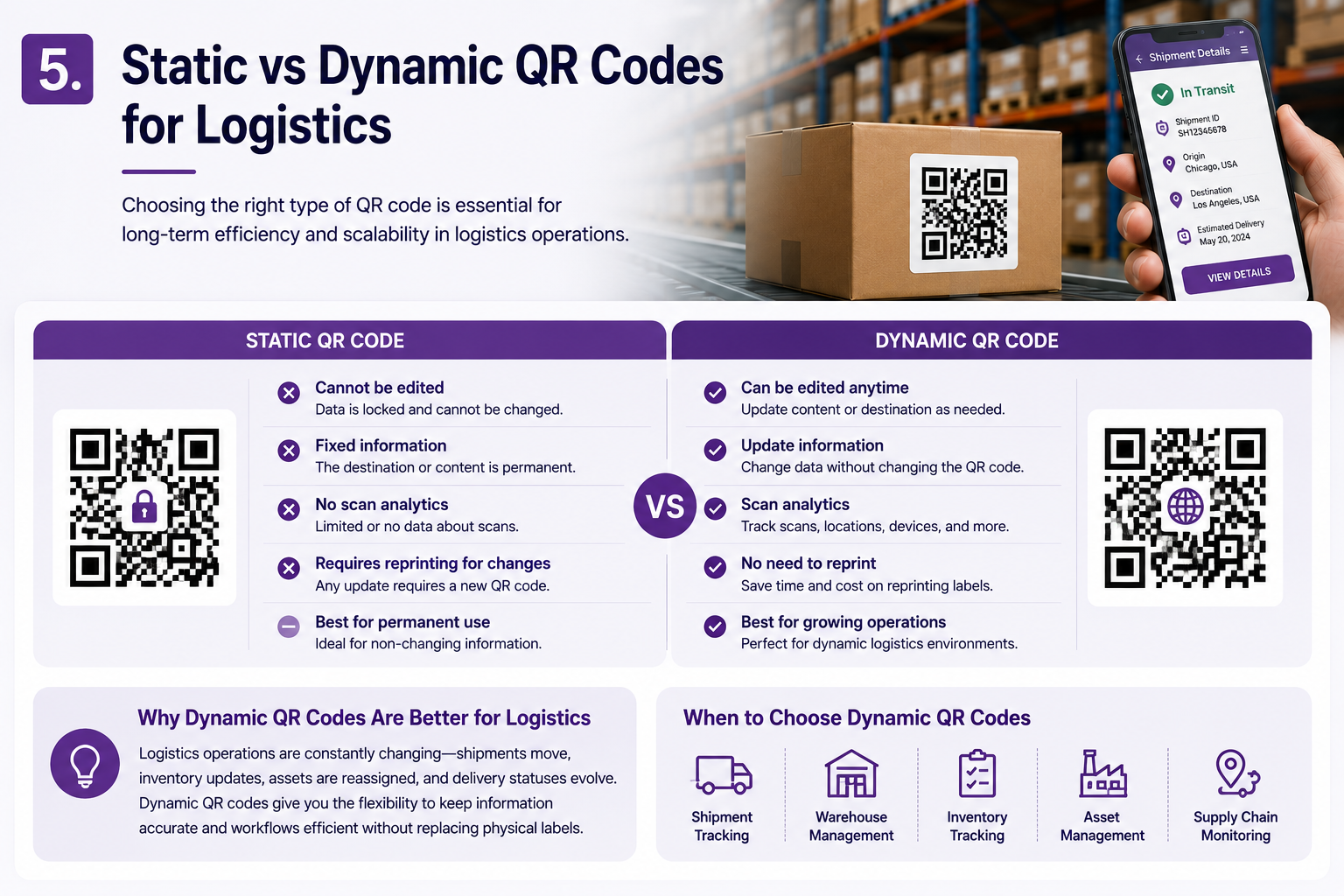
This is probably one of the most important decisions you'll make when implementing a QR code for logistics.
Many businesses focus on where they'll place the QR code.
Others focus on what information it should contain.
But they often overlook the type of QR code they're creating.
In my experience, that decision can have a bigger long-term impact than people expect.
What Is a Static QR Code?
A static QR code contains fixed information that cannot be changed after creation.
For example, if a QR code links to a shipment record or inventory page, that destination remains permanent.
If you later need to change the information, you'll typically need to generate and print a completely new QR code.
Static QR codes can work well for:
- Permanent warehouse locations
- Fixed product information
- Internal reference materials
- Long-term equipment labels
For simple use cases, they are often sufficient.
What Is a Dynamic QR Code?
A dynamic QR code acts differently.
Instead of storing the final destination directly, it points to a redirect that can be updated whenever necessary.
This means the QR code itself stays the same even if the information behind it changes.
For logistics operations, that flexibility can be extremely valuable.
Imagine you have hundreds of warehouse labels, asset tags, or shipment workflows already in circulation.
With dynamic QR codes, you can update linked information without replacing the physical codes.
That can save a significant amount of time and effort.
Side-by-Side Comparison
Feature | Static QR Codes | Dynamic QR Codes |
Editable After Creation | No | Yes |
Requires Reprinting for Changes | Yes | No |
Scan Analytics | Usually No | Yes |
Better for Large Operations | Limited | Yes |
Long-Term Flexibility | Low | High |
Logistics Scalability | Moderate | Excellent |
Which Option Is Better for Logistics?
For most modern logistics operations, I believe dynamic QR codes are the better choice.
That's because logistics environments constantly change.
Shipments move.
Inventory shifts.
Warehouses reorganize.
Assets are reassigned.
Processes evolve.
A static solution can become difficult to maintain as those changes accumulate.
Dynamic QR codes provide the flexibility needed to keep information accurate without creating additional administrative work.
They also offer another major advantage:
Depending on the platform, dynamic QR codes can provide insights such as:
- Number of scans
- Scan locations
- Scan dates
- Device types
- Usage trends
These insights can help logistics managers better understand how QR codes are being used throughout their operations.
When Should You Choose Dynamic QR Codes?
I typically recommend dynamic QR codes if you plan to use QR codes for:
- Shipment tracking
- Warehouse management
- Inventory tracking
- Asset management
- Delivery verification
- Supply chain monitoring
In short, if the information behind the QR code may change in the future, dynamic QR codes are usually the smarter investment.
The flexibility they provide becomes increasingly valuable as logistics operations grow.
And since supply chains rarely stay static for long, most businesses find themselves benefiting from that flexibility sooner than expected.
Best Practices for Implementing QR Codes in Logistics
Creating a QR code for logistics is easy.
Implementing it effectively across a supply chain is where the real challenge begins.
I've seen companies generate hundreds of QR codes only to discover later that employees aren't using them consistently or that the information behind the codes quickly becomes outdated.
A few simple best practices can help avoid those problems.
Standardize Your QR Code System
One of the biggest mistakes logistics teams make is creating QR codes without a clear structure.
Before deployment, decide:
- What each QR code will track
- Who will scan it
- When it should be scanned
- Which information should be displayed
Consistency makes large-scale logistics QR code management significantly easier.
Place QR Codes Where They're Easy to Scan
This sounds obvious, but it's surprisingly important.
QR codes should be:
✅ Visible
✅ Accessible
✅ Large enough to scan quickly
✅ Protected from damage
Whether you're labeling pallets, warehouse shelves, containers, or equipment, workers should be able to scan codes without interrupting their workflow.
Keep Linked Information Updated
A QR code is only as useful as the information behind it.
Outdated shipment records, incorrect inventory data, or incomplete asset information can reduce trust in the system.
This is another reason I generally prefer dynamic QR codes for logistics operations. They make it much easier to maintain accurate information over time without replacing physical labels.
Train Employees Early
Even the best technology fails if people don't use it correctly.
Before launching a new warehouse QR code system, make sure employees understand:
- Why QR codes are being used
- How scanning fits into daily workflows
- What information should be updated
- How exceptions should be handled
The goal is to make scanning feel like a natural part of operations rather than an additional task.
Start Small, Then Scale
You don't need to transform your entire supply chain overnight.
In fact, I usually recommend starting with one high-impact area such as:
- Shipment tracking
- Inventory management
- Asset tracking
Once teams become comfortable with the process, expanding QR code usage becomes much easier.
Focus on Long-Term Visibility
The most successful logistics QR code deployments are not just tracking systems.
They're visibility systems.
Every scan creates a digital record.
Every digital record improves transparency.
And every improvement in transparency helps logistics teams make better decisions.
That's ultimately where the real value of QR codes comes from—not simply identifying products, but creating a more connected and visible supply chain.
Conclusion
A QR code for logistics may seem like a small addition to an operation, but its impact can be surprisingly significant.
From QR code shipment tracking and inventory tracking QR code systems to asset management and supply chain visibility, QR codes help connect physical operations with real-time digital information. The result is faster workflows, fewer manual errors, better transparency, and more efficient logistics management.
What I find most compelling is that QR codes are not limited to large enterprises. Whether you're managing a single warehouse or coordinating a complex global supply chain, they offer a practical and scalable way to improve operational efficiency.
And as logistics continues to become more data-driven, the ability to instantly access accurate information will only become more valuable.
If you're ready to implement dynamic QR codes for logistics, inventory management, or supply chain operations, QRCode Dynamic makes it easy to create, manage, and update QR codes at scale from a single dashboard.
👉 Start building smarter logistics workflows with QRCode Dynamic and discover how a simple scan can make your entire operation more connected.
Frequently Asked Questions
How are QR codes used in logistics?
QR codes are used in logistics for shipment tracking, inventory management, asset tracking, warehouse operations, delivery verification, and supply chain traceability. A single scan can provide instant access to real-time operational data.
Can QR codes track shipments?
Yes. A QR code shipment tracking system allows logistics teams to monitor package movements throughout the supply chain. Each scan can update shipment status, location, and delivery information within connected logistics platforms.
What is the difference between barcodes and QR codes in logistics?
Traditional barcodes typically store limited information and serve as identifiers. QR codes can store significantly more data and connect directly to digital systems, making them better suited for modern logistics management, inventory tracking, and supply chain visibility.
Are dynamic QR codes better for logistics operations?
In most cases, yes. Dynamic QR codes allow businesses to update linked information without replacing existing codes. They also support scan analytics and offer greater flexibility for growing logistics operations.

I work as a Growth Marketer at Popupsmart, using my 3+ years of SaaS experience to create clear, useful marketing content that helps brands grow, reach the right audiences, and improve their results.