QR Code Advertising: Benefits, Use Cases & Real-World Examples

On this page
- Why QR Codes Matter in Advertising in 2026
- How QR Codes Can Be Used in Advertising
- 1. Print Advertising
- 2. Billboards and Outdoor
- 3. Packaging and Product Labels
- 4. Out-of-Home (OOH) and Transit
- 5. TV and CTV/OTT Advertising
- 6. Event Marketing
- 7. Direct Mail Campaigns
- 8. Social Media and Influencer Posts
- Real-World QR Code Advertising Examples
- Coca-Cola's Share a Song Campaign
- Hershey's HerShe Campaign
- L'Oreal in NYC Taxis
- Burger King's Pandemic Discount Campaign
- Audi's CTV/OTT Campaign
- Pepsi's Super Bowl QR Spot
- Walmart, GM, Taco Bell, and Tesco
- AI-Enhanced QR Codes in 2026
- How to Implement QR Code Advertising with QR Code Dynamic
- 1. Set the Goal Before You Generate the Code
- 2. Choose a Generator That Supports Dynamic Codes
- 3. Design for Scannability First, Brand Second
- 4. Write the CTA on the Asset
- 5. Build the Landing Page Before You Print
- 6. Test Before You Print
- 7. Track Scans From Day One
- 8. Iterate on the Destination, Not the Print
- Creative QR Code Ideas for Small Businesses
- Benefits of QR Code Advertising
- 1. Higher Engagement and Conversion
- 2. Cost-Effective Data and Analytics
- 3. Better Brand Image
- 4. Multi-Channel Versatility
- 5. Scalability and Adaptability
- Make QR Code Advertising Work for Your Brand
- FAQs About QR Code Advertising
- How do you advertise with a QR code?
- Do QR codes actually work in advertising?
- What is the ideal size for a QR code in a print ad?
- How do you get people to actually scan your QR code?
- What types of content work best for QR code advertising?
- How can small businesses integrate QR codes with social media?
QR code advertising places a scannable QR code on print, packaging, billboards, TV, or video ads so a smartphone scan opens a landing page, video, coupon, or app. It turns one-way ads into measurable, trackable interactions, and in 2026 it's how most brands close the gap between offline impressions and online actions.
Why QR Codes Matter in Advertising in 2026
QR codes stopped being a pandemic novelty years ago. They're now a default part of how people interact with physical ads — restaurant menus, packaging, posters, even Super Bowl spots. The reason is simple: phones got better at reading them, and consumers got used to scanning.
I've worked on QR campaigns for the past three years, and the shift I see in 2026 is that marketers don't argue about whether QR codes belong on an ad anymore. The argument now is what to link to and how to measure the result.
Across Air Apps data covering 50 countries, QR code scans surged 57% year over year in 2025, with over one trillion scans expected worldwide across the year. That's not a fringe channel — that's behavior at scale.
And the audience is wide. Air Apps also reports that 84% of mobile users worldwide have scanned a QR code at least once. The friction is gone. The remaining work is on the marketer's side: design, placement, and what happens after the scan.
A few reasons QR code advertising earns its place in a 2026 media plan:
- It closes the offline-to-online loop. A billboard, a magazine spread, or a 30-second TV ad can now drive a measurable click — not just a brand impression.
- It's editable post-print. With a dynamic QR code, you can swap the destination URL without reprinting the asset. Run a holiday promo on a poster you printed in September.
- It carries analytics. Scan counts, scan locations, time-of-day, device type, and unique-vs-repeat scanners are all measurable.
- It's cheap to test. Generating a code costs nothing. Testing whether your audience scans is the cheapest market research you'll run this quarter.
The catch: a QR code only works if the offer behind it is worth a scan. The LinkedIn industry pulse for 2026 found that 75% of consumers scan QR codes to get more information — that's the top reason, ahead of discounts and ahead of payments. People scan when they want to learn more about the thing they're already looking at. Keep that in mind when you write your call to action.
How QR Codes Can Be Used in Advertising
The use cases are wide because the format is flexible — a code can live anywhere there's a flat surface or a screen. Here are the channels where QR code advertising pulls real weight in 2026.
1. Print Advertising
Magazines, newspapers, flyers, and direct mail are the easiest entry points. Embed a code that links to a product demo, a coupon, or a content piece that expands on the printed message. For local businesses, this is where I'd start — a poster in your window with a QR code to a same-week discount converts faster than most paid social ads.
Our guide on QR codes for print media covers the full setup if you're new to this format.
2. Billboards and Outdoor
Billboards used to be a brand-awareness play with no measurement attached. A QR code on a billboard changes that — drivers and pedestrians get a way to act on the ad, and you get a scan count. The rule I follow: the code should fill at least 10% of the billboard surface so it scans from a normal viewing distance. Our piece on QR codes on billboards walks through sizing and placement.
3. Packaging and Product Labels
Coca-Cola, Hershey's, and dozens of CPG brands now ship products with QR codes printed directly on the package. The link can go to a brand story video, a recipe, a how-to guide, an authenticity check, or a loyalty program signup. Hershey's HerShe campaign linked chocolate bars to videos of inspiring women — a single scan turned a $2 bar into a brand moment.
4. Out-of-Home (OOH) and Transit
Transit ads — taxis, buses, subway cars — get long dwell times. Passengers are already on their phones. L'Oreal's taxi campaign linked codes to product tutorials and saw app downloads spike 80% from in-transit scans. Bus shelters, airport posters, and gas-pump screens work for the same reason: captive attention plus a phone in hand.
5. TV and CTV/OTT Advertising
This is the channel that grew the fastest between 2024 and 2026. Connected TV and streaming ads are non-clickable by default, but a QR code gives viewers a second-screen path. AOL reports 102.6 million people — roughly 1 in 3 Americans — will scan a QR code in 2026, and a large share of that scanning happens during ad breaks.
Super Bowl ads, late-night spots, and streaming pre-rolls all use QR codes now. Hold the code on screen for at least 5-10 seconds and size it large enough to scan from couch distance.
6. Event Marketing
Booths, tickets, badges, posters at the venue — events are dense with QR scan opportunities. Use them for lead capture, content gates, hybrid streaming links, or instant giveaways. I've seen booths capture 3x more leads by replacing paper signup sheets with a QR code that opens a one-field form.
7. Direct Mail Campaigns
Direct mail open rates are higher than email, but the click problem has always been weak. A QR code on a postcard linking to a personalized landing page closes that gap. The MDL Marinas Group case study tracked on Target Internet captured 900 customer emails last year through a campaign with QR codes at its core — a number that would've been near-impossible from print mail alone.
8. Social Media and Influencer Posts
Codes inside influencer posts, podcast cover art, YouTube thumbnails, and Instagram story screenshots let followers scan from their TV or laptop screen with a second device. It sounds niche, but the cross-screen behavior is now mainstream.
Real-World QR Code Advertising Examples
Theory only goes so far. The campaigns below are the ones I cite most when clients ask "is this actually working?" Each one paired a creative idea with a clear post-scan destination — which is the only thing that separates QR ads that convert from QR ads that get ignored.
Coca-Cola's Share a Song Campaign
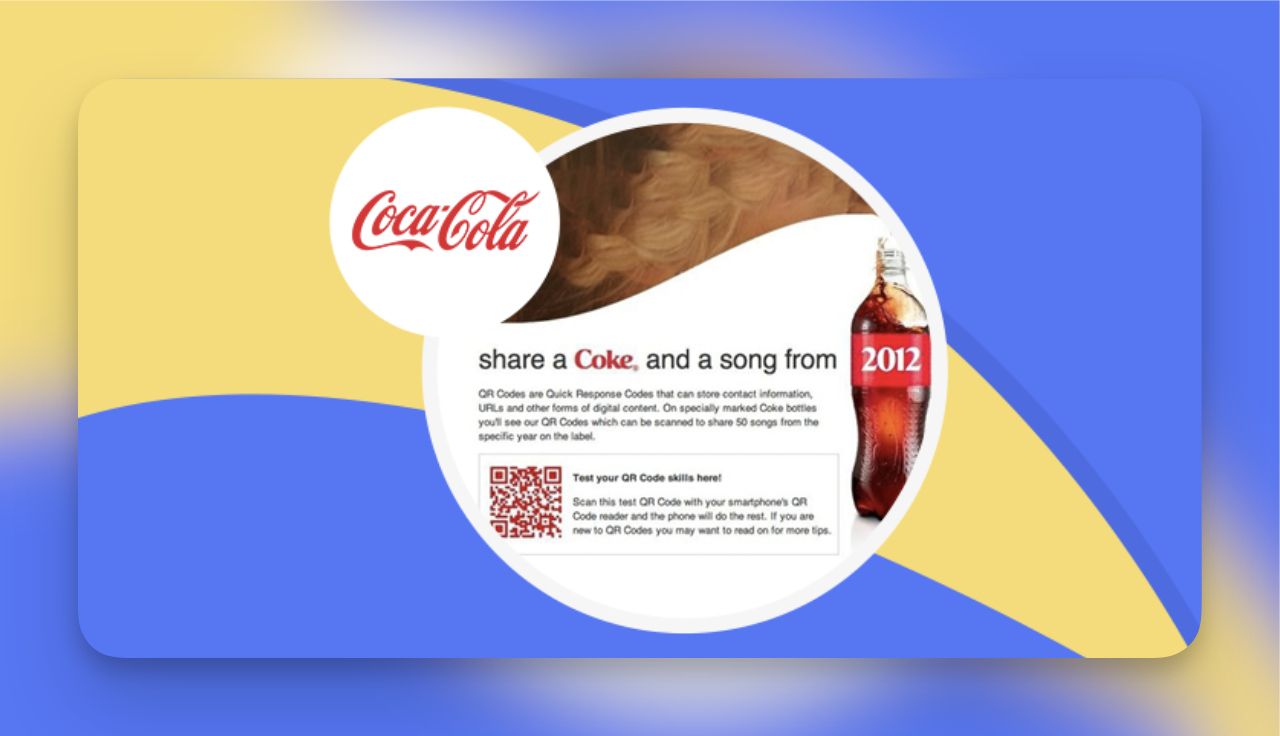
Coca-Cola printed QR codes on cans and bottles. Scanning launched an augmented reality experience where users could "share a song" — turning a 90-second drink moment into a multi-minute brand interaction. The genius was the post-scan payoff: not a coupon, not a website, but a memorable AR moment that felt worth a screenshot.
Hershey's HerShe Campaign
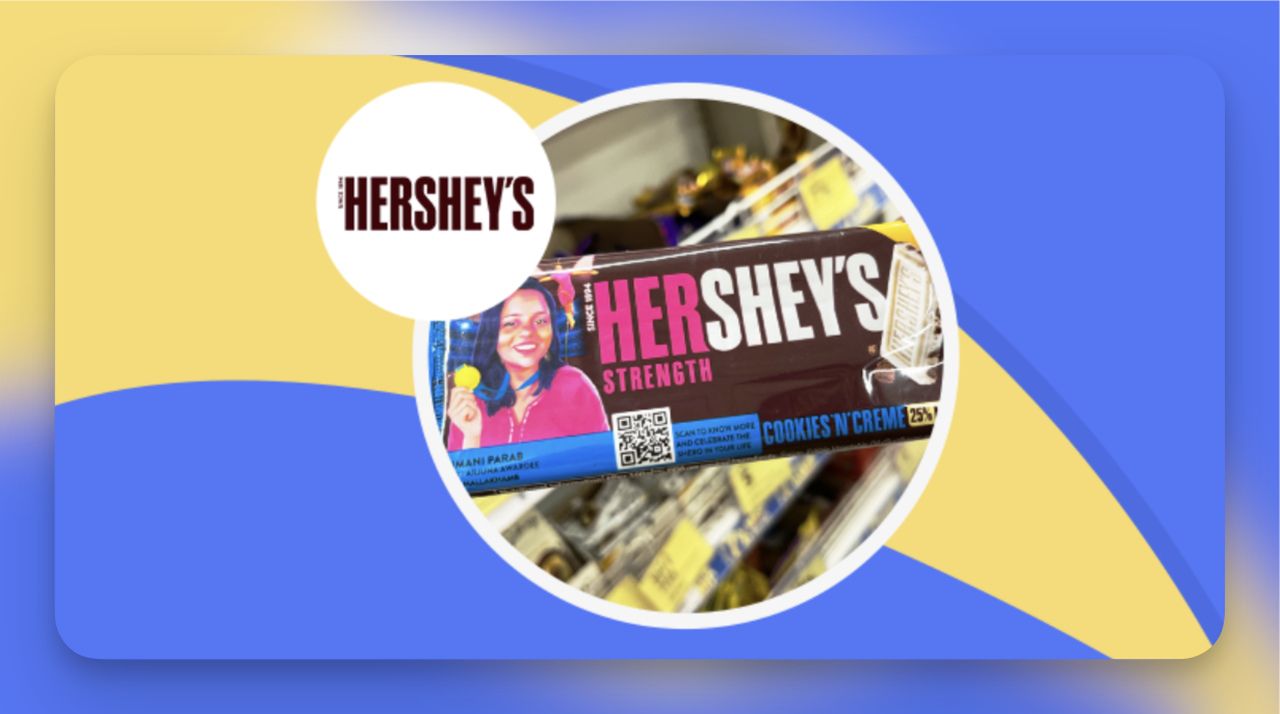
HerShe bars carried QR codes that linked to videos celebrating real women's stories. Each bar became a small piece of media. Hershey's didn't try to sell more chocolate with the scan — they tried to build affinity, and the scan rates told them it worked.
L'Oreal in NYC Taxis
L'Oreal placed QR codes inside NYC taxi screens. Passengers scanned during their commute to access tutorials and shop products. Reported app downloads jumped 80% off the back of the campaign. The lesson: match the post-scan content to the moment. A bored cab passenger has eight to twenty minutes — long enough for a real tutorial, not just a coupon.
Burger King's Pandemic Discount Campaign
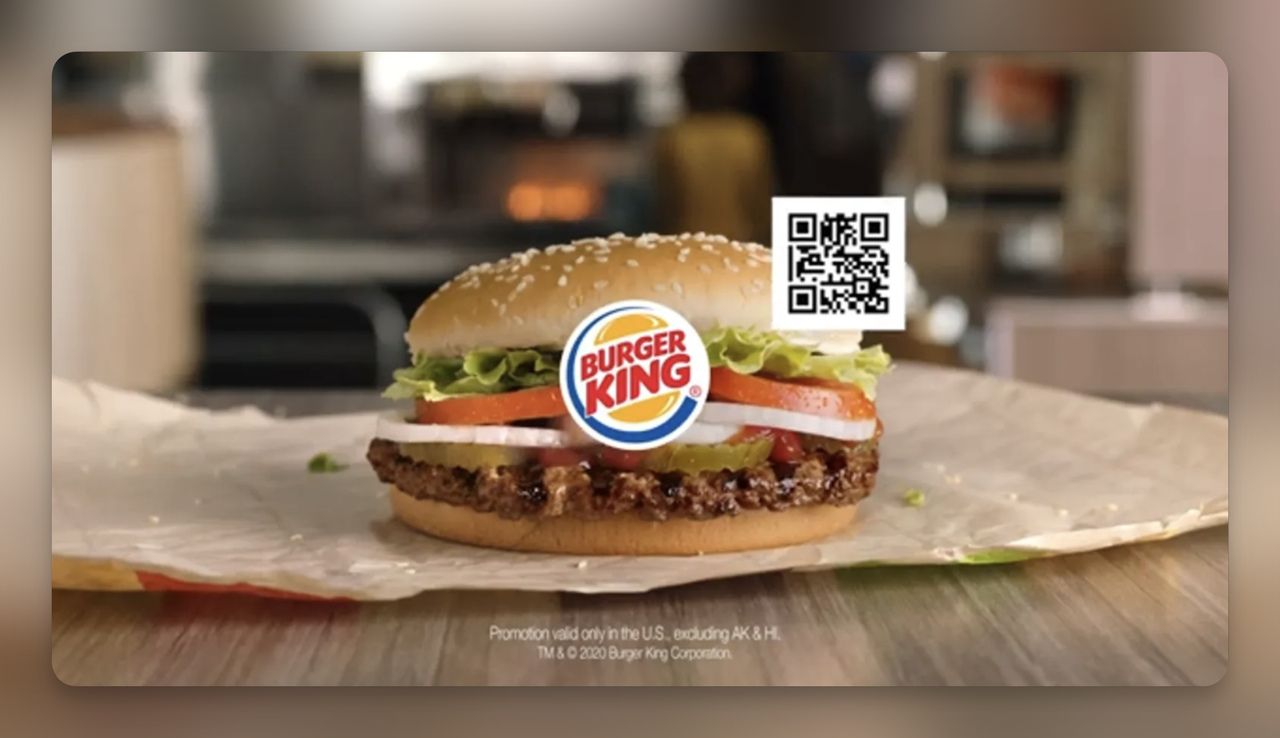
Burger King ran on-screen QR codes during TV spots, sending viewers directly to discounted orders. It worked because the offer was concrete (a real discount, not a brand splash page) and the scan was timed to the moment the viewer was already thinking about food.
Audi's CTV/OTT Campaign
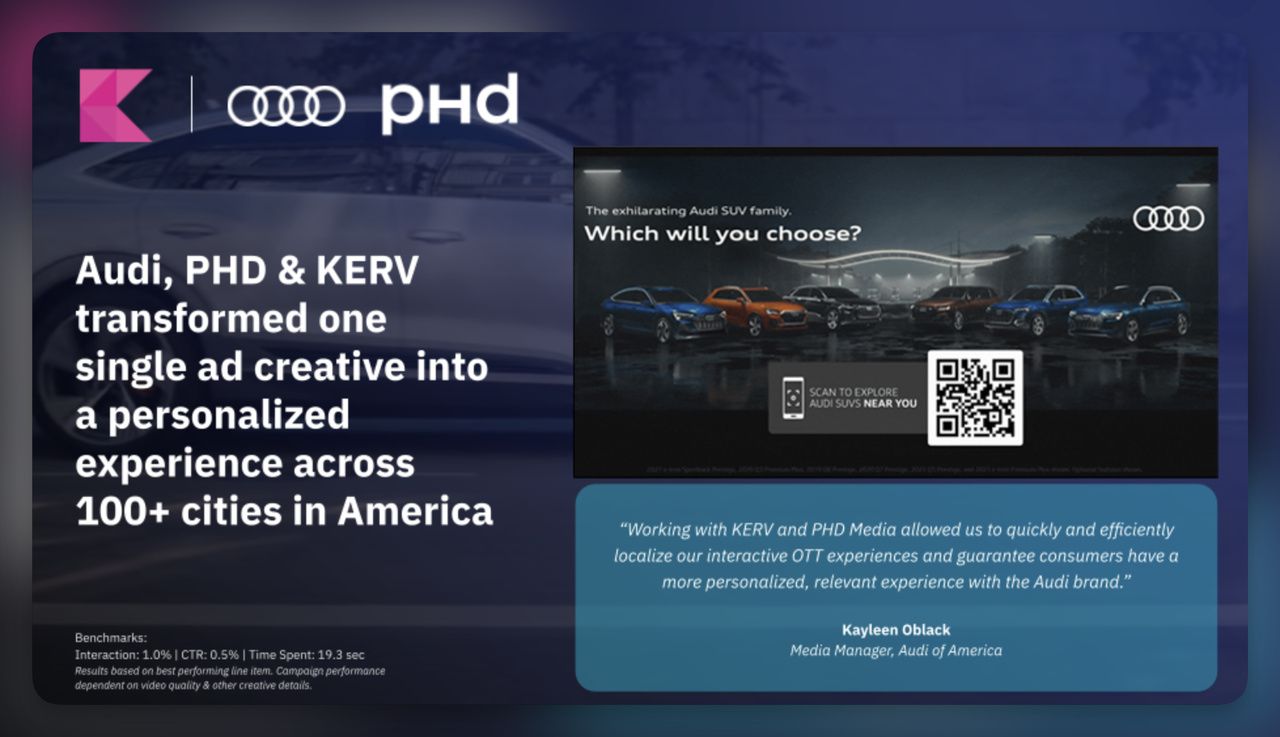
Audi ran dynamic QR codes across CTV and OTT inventory. The destination URL changed based on the viewer's time of day and location — a morning viewer in Chicago might land on a winter-package page, while an evening viewer in Miami got a different lease offer. That's where dynamic QR codes earn their keep: the print or video asset stays the same, but the link adapts.
Pepsi's Super Bowl QR Spot
Pepsi used a Super Bowl moment to drop a full-screen QR code that opened user-generated polls and content. The campaign was loud, simple, and turned millions of passive viewers into a measurable engagement pool inside the same 30-second window. Super Bowl 2022's Coinbase bouncing QR code is the more famous version of the same idea — and it's the spot that taught every CMO that a QR ad can crash your servers if the offer is strong enough.
Walmart, GM, Taco Bell, and Tesco
A few faster-moving examples:
- Walmart's virtual toy store placed QR codes in-store so kids could "shop" the digital catalog from physical aisles.
- General Motors built QR codes into vehicle interiors so owners could pull up manual content and feature explanations.
- Taco Bell's edible QR codes printed scannable codes on food wrappers — gimmicky, viral, and a perfect social share.
- Tesco's virtual subway stores in South Korea let commuters shop groceries from QR-coded posters during their wait.
The pattern across every successful example: a clear reason to scan, a payoff that respects the viewer's time, and a tracked destination so the marketer can prove it worked.
AI-Enhanced QR Codes in 2026
One change worth flagging for anyone planning a campaign this year: QR codes increasingly link to AI experiences, not just landing pages. Scan a product label and you can talk to a brand-trained chatbot. Scan a restaurant menu and an AI recommender narrows your order based on a one-line preference. Scan a museum exhibit and a voice guide adapts to what you ask.
It's still early — most brands haven't shipped this yet — but the infrastructure is cheap enough now that I expect AI-backed QR destinations to be normal in B2C campaigns by late 2026. If you're planning a campaign for the back half of the year, ask whether the landing page should be a chatbot instead of a static page.
How to Implement QR Code Advertising with QR Code Dynamic
Implementation is where most campaigns stumble. The design and creative are usually fine. What breaks is placement, scan quality, or a landing page that loads slowly on mobile and kills the click. Here's the implementation order I use.
1. Set the Goal Before You Generate the Code
You should be able to finish this sentence in one breath: "When someone scans this code, I want them to ____." Possible endings: buy a product, sign up for an email list, watch a video, get a coupon, leave a review, install an app, book a demo. Pick one. Don't try to do three things with one scan.
Once you have the verb, define the metric. Scan count is fine for awareness campaigns. Conversion rate per scan is what matters for direct response. Yahoo Finance flagged a gap worth knowing: 56% of marketers expect QR codes to drive higher revenue, but only 12% currently measure their impact on revenue. Be in the 12%.
2. Choose a Generator That Supports Dynamic Codes
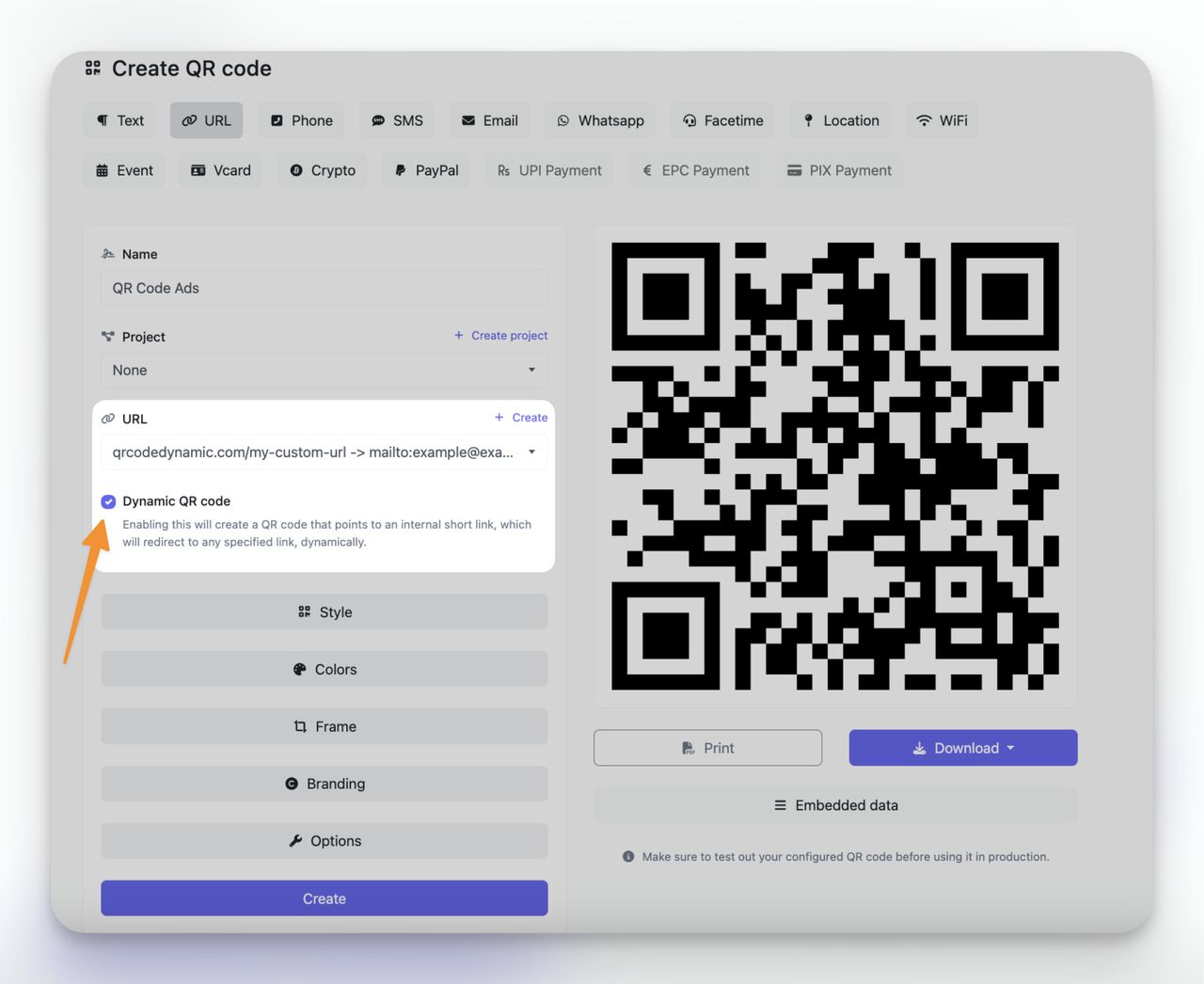
Static QR codes encode the destination URL directly into the pattern, so the link is locked at print time. Dynamic QR codes encode a short tracking URL that redirects — which means you can change the destination URL at any time without reprinting the asset. That's the real edge for any campaign that runs longer than a few weeks. With QR Code Dynamic, the toggle is right in the editor — flip it on before you generate.
You can read more on how to change a QR code destination after print if you need to mid-campaign.
3. Design for Scannability First, Brand Second
The most scannable QR code is plain black on white at a 1-inch minimum print size. Brand elements — logo in the middle, color, frame — are fine as long as you keep the contrast high and the dark modules unbroken. Test on three or four devices before sending the file to the printer.
Our QR code size guide covers print sizing in detail, including the 10:1 scan-distance rule (one inch of code per ten feet of scan distance).
4. Write the CTA on the Asset
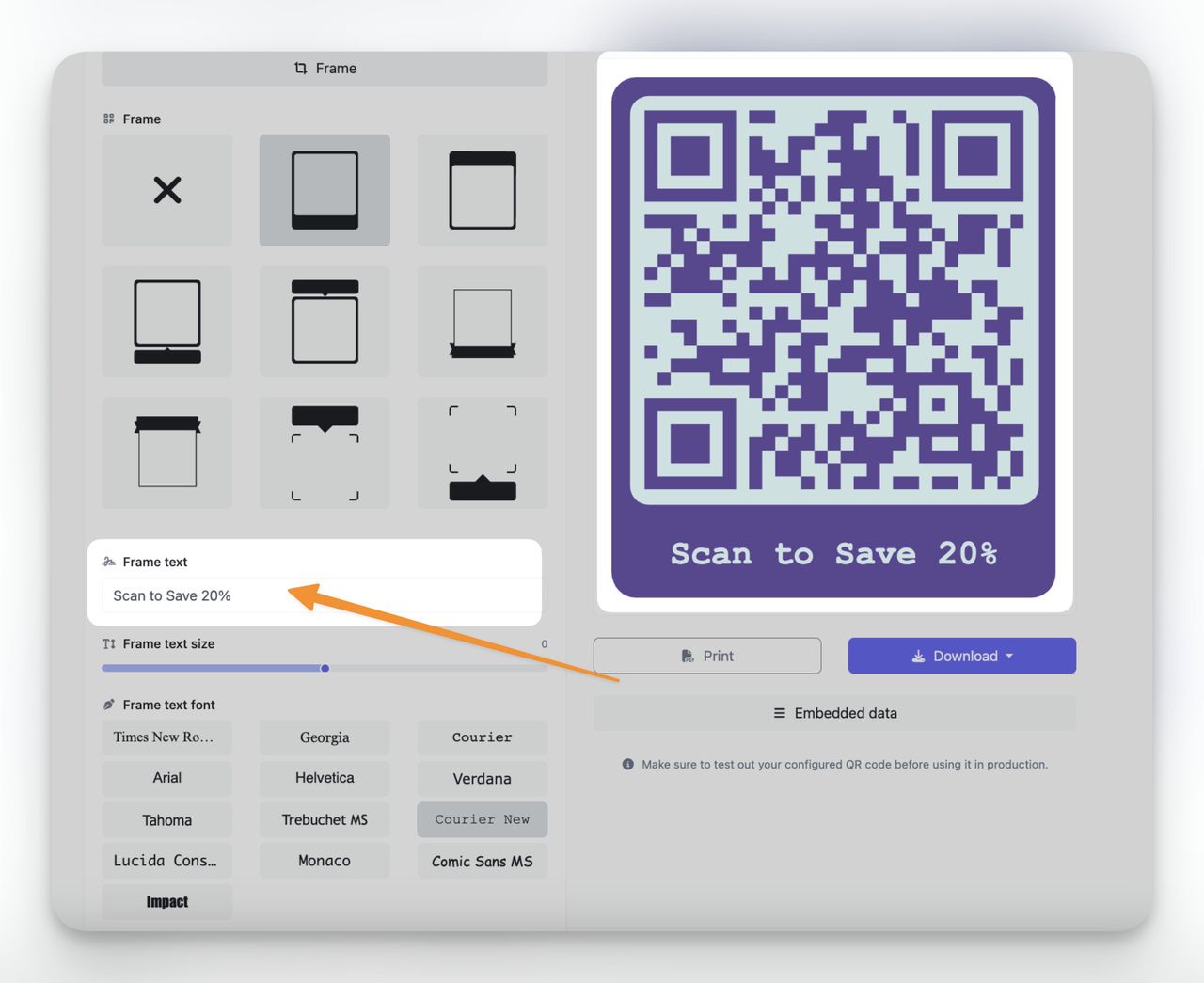
A QR code with no CTA is a square nobody scans. "Scan to save 20%" outperforms "Scan me" by a wide margin. "Scan to watch the 90-second tutorial" outperforms both. Tell the viewer exactly what they get and roughly how long it takes.
5. Build the Landing Page Before You Print
The landing page is the campaign. Mobile-first, sub-2-second load time, the offer above the fold, one clear next action. If the page can't load on a 3G connection in under three seconds, the scan is wasted. I've watched campaigns lose 60% of scanners on a slow landing page.
6. Test Before You Print
Run the code through at least four phones: a recent iPhone, an older iPhone, a recent Android, and an older Android. Test in bright sunlight and in dim indoor light. Test the landing page on cellular, not just office Wi-Fi. Every campaign I've shipped without this step has had a problem I caught only after the asset was printed and distributed.
7. Track Scans From Day One
Add UTM parameters to the destination URL so scans show up in your analytics platform. Use one UTM per placement (one for the magazine, one for the billboard, one for the TV spot) so you can compare which surface produced which result. The dashboard in QR Code Dynamic shows scan count, scan location, time, and unique vs. repeat scans — feed that into your campaign report.
8. Iterate on the Destination, Not the Print
This is where dynamic codes earn their cost. If scans are coming in but conversions aren't, change the landing page. If scans are flat, change the CTA on the next print run or move the placement. Don't reprint until the data tells you the surface is the problem.
Creative QR Code Ideas for Small Businesses
You don't need a Super Bowl budget to make QR advertising work. The campaigns I've seen pay off fastest for small operators tend to be cheap, local, and tied to a specific offer.
- Window posters with a same-week coupon. A bakery I worked with put a QR code on its window linking to a 15% discount valid that week only. Foot traffic jumped on slow weekday afternoons.
- Table-top codes for review collection. Restaurants and salons put a QR code on the receipt or table card linking straight to their Google review page. Review volume tripled in 60 days for one client.
- Business card QR codes. Replace the long URL on your card with a code that opens a saved-contact vCard, your portfolio, or a calendar booking link.
- Loyalty signup at checkout. A QR code at the register that opens a one-field email signup is faster than a paper form and works on any device.
- Packaging "thank you" page. An e-commerce shipment with a small card and a QR code linking to a personal thank-you video — sticky and cheap.
- Event flyer with RSVP. Print flyers around the neighborhood with a code that opens a one-field RSVP. Cheaper than Facebook events and measurable.
- Menu-to-recommendations. A QR code on the menu that opens a wine pairing chart or allergen filter — high perceived value, zero cost per use.
- Window-shopping after hours. Retailers with closed storefronts can put a QR code in the window so passersby can shop online when the store is closed. The store sells overnight.
For more on display formats, our piece on creative QR code display ideas goes deeper. And the global trend is on your side — the Wave Connect 2025 statistics report notes the global QR code market is valued at $13.04 billion in 2025 and projected to reach $33.14 billion by 2030, growing at a 20.5% CAGR. The infrastructure, the consumer comfort, and the tooling are all already there.
Benefits of QR Code Advertising
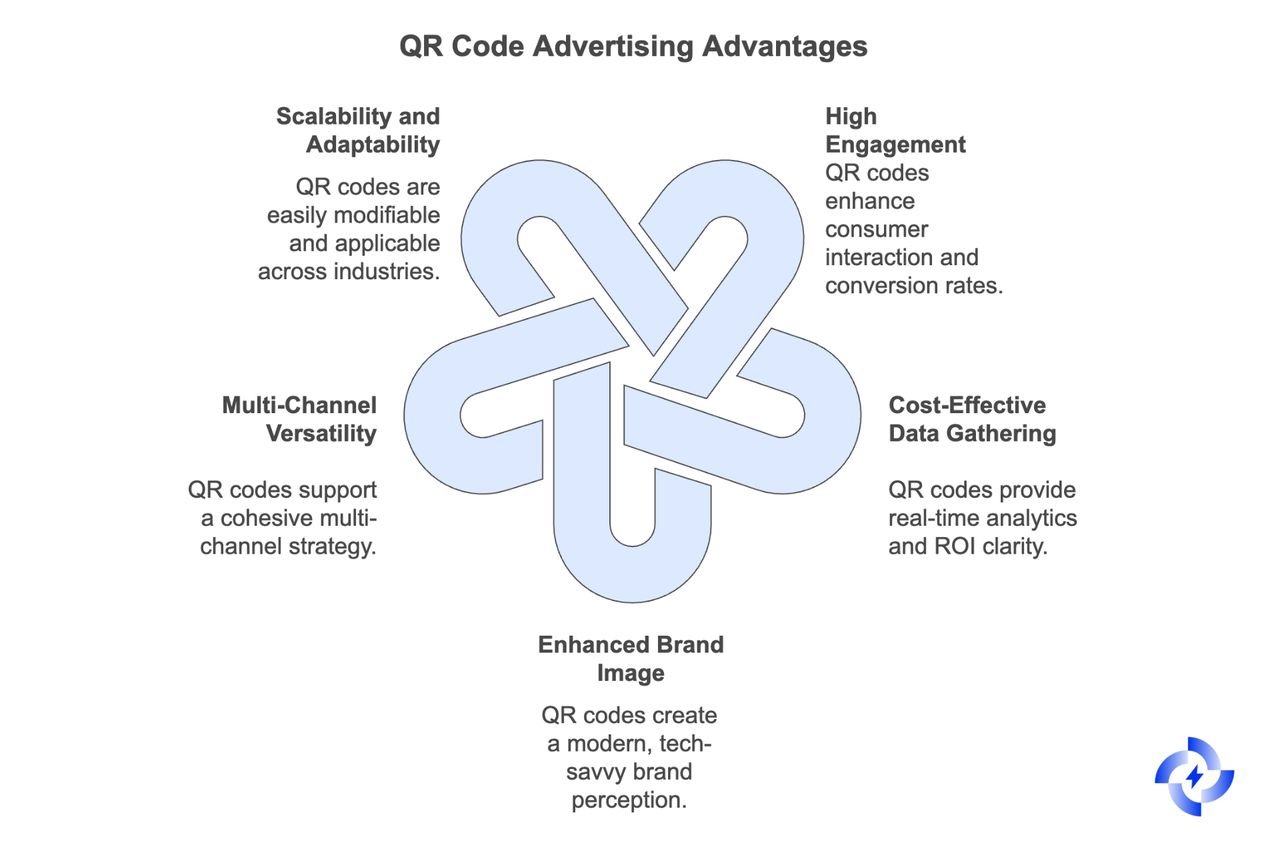
Five reasons QR code advertising earns its slot in a 2026 media plan — these are the ones I see show up across nearly every campaign that pays off:
1. Higher Engagement and Conversion
A scan is closer to a click than to an impression. Viewers who scan have already made the decision to engage — that intent shows up in conversion rates. According to PRNewswire, 71% of consumers say QR codes are useful in their daily lives, and 98% of marketers report a positive impact on their marketing over the past 12 months.
2. Cost-Effective Data and Analytics
Traditional print ads tell you how many copies you printed. QR codes tell you how many people scanned, when, where, and on what device. Dynamic codes layer in landing-page analytics on top of that — every scan becomes a row in your data, not a guess.
3. Better Brand Image
A QR code on a print ad signals that the brand is paying attention to the channel. It's a small signal, but it tells a younger buyer that the company isn't stuck in 2015. The flip side: a code that doesn't scan, or a slow landing page, signals the opposite. The benefit is only real if execution holds up.
4. Multi-Channel Versatility
One code can run on a billboard, a flyer, a TV spot, a coffee cup, a podcast cover, and an Instagram story. The destination stays consistent. The customer experience stays consistent. The measurement stays consistent.
5. Scalability and Adaptability
Dynamic codes let you change the destination as the campaign matures — A/B testing landing pages, swapping the holiday offer for the new-year offer, redirecting old codes to fresh content. You don't lose the printed asset; you upgrade what it points to.
Make QR Code Advertising Work for Your Brand
The hard part of QR code advertising in 2026 isn't the QR code anymore. The phones can read it. The audience knows how to scan. The tooling is cheap. The hard part is everything around the code — the offer, the landing page, the placement, the tracking. Get those right and a QR code on a flyer can outperform a paid social campaign.
Here's how I'd start if I were running my first campaign tomorrow:
- Pick one channel — a single placement (one poster, one mailer, one TV spot). Don't try to run a multi-channel test before you know what works once.
- Pick one offer — something specific enough that scanning feels worth it. A discount with a deadline, a tutorial with a duration, a free download with a clear payoff.
- Build the landing page first — mobile, fast, one action.
- Generate a dynamic code with QR Code Dynamic so you can iterate on the destination after print.
- Track everything from scan one. UTMs on the URL. Scan analytics in the dashboard. Conversion events on the landing page.
- Read the data after two weeks and change what's not working.
The brands that get the most out of QR advertising in 2026 aren't the ones with the cleverest creative. They're the ones who treat the scan as the start of a tracked funnel, not the end of an ad. Start small, measure honestly, and keep the loop tight between print and dashboard.
FAQs About QR Code Advertising
How do you advertise with a QR code?
Pick a single goal (a scan should drive a sale, a signup, a video view, or an app install), generate a dynamic QR code, build a fast mobile landing page for it, place the code on a print, packaging, OOH, or video asset with a clear scan-to-do-X call to action, and track every scan with UTM parameters. The simplest first campaign: a window poster with a "Scan to save 20% this week" offer, linked to a coupon page.
Do QR codes actually work in advertising?
Yes — and the data has caught up with the hype. Scans grew 57% year over year in 2025, 84% of mobile users have scanned a code at least once, and 98% of marketers in Uniqode's 2026 report saw positive impact from QR codes in the past 12 months. The brands that fail with QR aren't failing because the format is broken — they're failing because the offer or the landing page didn't earn the scan.
What is the ideal size for a QR code in a print ad?
At least 1x1 inch for handheld print materials like flyers, business cards, and magazine ads. Use the 10:1 rule for larger formats — one inch of code per ten feet of scan distance. A billboard scanned from across a parking lot needs to be much bigger. Always test in both bright and low-light conditions before printing the final asset.
How do you get people to actually scan your QR code?
Three things: a clear CTA that names the payoff ("Scan to watch the 60-second demo" beats "Scan me"), a placement where the viewer's hands are free and their phone is nearby, and an offer worth two seconds of attention. Discounts work. Exclusive content works. Time-sensitive offers work best — they convert curiosity into action.
What types of content work best for QR code advertising?
Content that pays off the scan in under a minute: a coupon, a 60-90 second video, a one-field signup, an AR or interactive moment, a downloadable resource, or a personalized landing page. Long-form content (a 3,000-word whitepaper, a 10-minute video) tends to underperform because the scan is usually a moment of opportunistic curiosity, not a research session.
How can small businesses integrate QR codes with social media?
Use dynamic codes to link print and packaging to your social profiles, an active campaign post, a UGC contest entry form, or a loyalty signup that auto-follows your Instagram. The bridge works both ways: a code on your storefront drives social followers, and a code in your social posts drives offline visits during a promo window.
Discover our other blog posts before you go:

I work as a Growth Marketer at Popupsmart, using my 3+ years of SaaS experience to create clear, useful marketing content that helps brands grow, reach the right audiences, and improve their results.